
Intra-EU shipping of research materials: what applies for customs and VAT
There is no customs procedure inside the EU — but there is an intra-Community acquisition, a recapitulative statement, and a documentation file somebody has to keep.
A parcel that leaves one EU Member State and arrives in Greece does not clear customs. No import declaration is lodged, no EORI number is needed, no duty is owed, and no "clearance fee" is legally justified. The reason is single and technical: the goods are already Union goods in free circulation within the meaning of the Union Customs Code, and moving them between Member States is not an importation [2].
What replaces customs is not nothing. It is two obligations that fall mainly on the consignee: a fiscal one, the intra-Community acquisition, and a documentary one, the file that proves the shipment actually moved and that the invoice tells the truth. And there is a third thing, which in practice stops more parcels than any customs inspection ever did: the legal status of the material itself, and the rules governing how it travels.
Why there is no customs inside the EU — and when it suddenly reappears
A customs union means one customs territory with a common external tariff. Regulation 952/2013 defines Union goods as those produced in that territory, or imported and released for free circulation; once goods hold that status, they keep it while moving inside the Union [2]. Customs is not being "bypassed" — it simply has nothing to act on.
There are, however, three situations in which customs reappears in a shipment you assumed was intra-Community:
- The goods were never Union goods. A parcel that started in a third country and was merely transhipped through an EU hub does not change status because the last scan happened in Leipzig or Liège; a sender address on the label is no proof of origin.
- The destination sits outside the VAT territory. Article 6 of Directive 2006/112/EC expressly excludes certain territories that form part of the Union customs territory — among them Mount Athos, together with the Canary Islands and the Åland Islands [1]. A supply to those territories is not an intra-Community supply: for VAT purposes it is treated as an export, with everything that implies for the paperwork.
- The carrier declared the parcel as an import. A miscoding at a sorting hub produces a real customs procedure and real charges, which somebody then has to have cancelled with evidence.
Intra-Community acquisition: who accounts for the VAT, and where
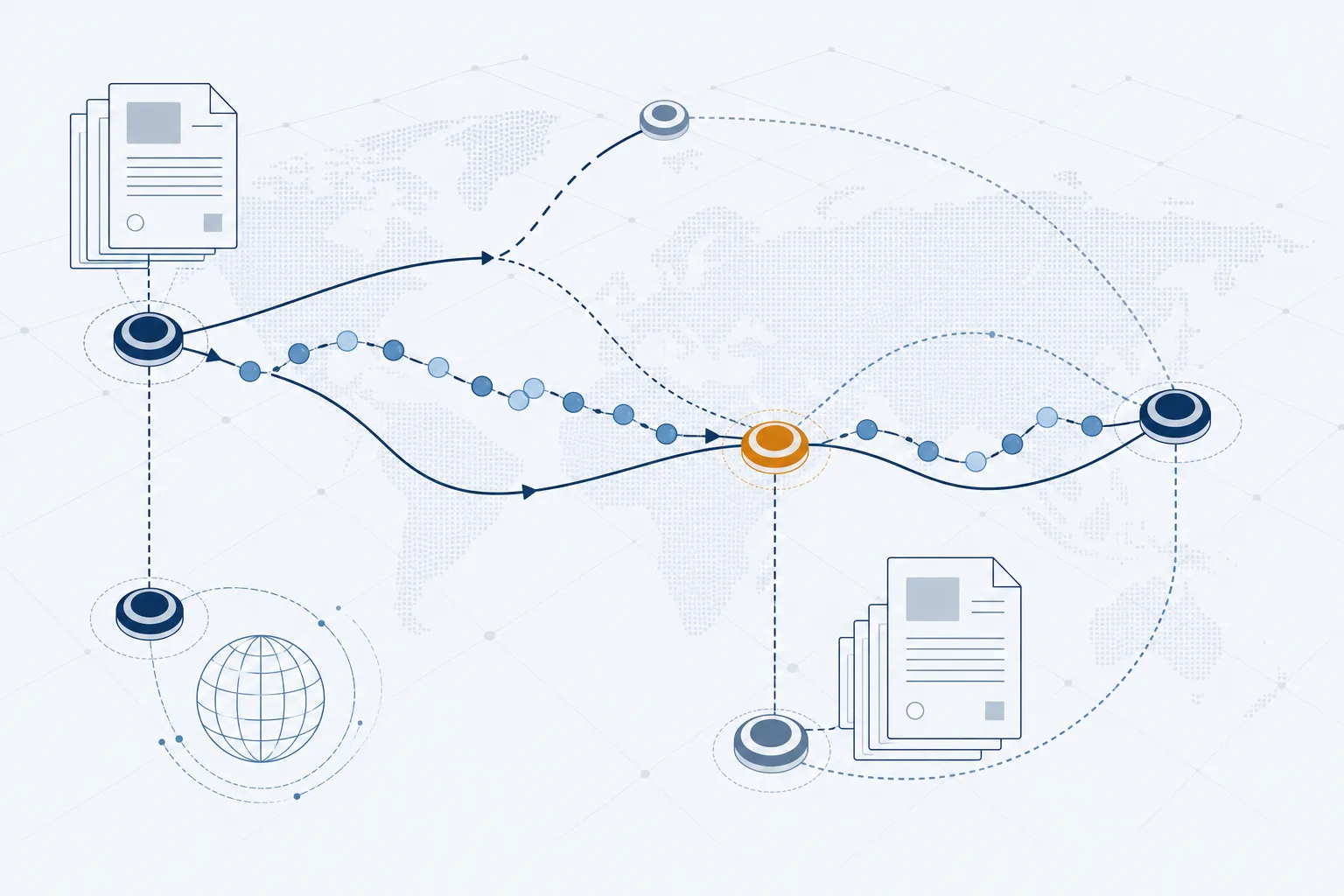
The basic mechanism is symmetrical. The supplier in another Member State makes an exempt intra-Community supply under Article 138 of the VAT Directive [1], and the consignee in Greece makes an intra-Community acquisition, which is taxed where the goods arrive. In Greek law the acquisition is governed by Article 14 of the VAT Code and the corresponding exemption for the supply by Article 33 [3].
Note one point that older texts get wrong: the Greek VAT Code is no longer Law 2859/2000. It was replaced by Law 5144/2024, which renumbered the articles [3]. If a supplier or an accountant still refers you to "Article 11", the citation is out of date even when the substance is right.
The rate applied to the acquisition is the domestic rate at the place of arrival, not the rate in the supplier's country: 24% across most of the country. From 1 January 2026, rates reduced by 30% apply on islands of the North Aegean, Samothraki and the Dodecanese with a population up to 20,000, meaning 17% instead of 24%, subject to conditions on where the recipient is established [3]. For a laboratory on such an island, that difference is not a bookkeeping detail.
| Who receives the goods | What the supplier does | What the consignee owes in Greece |
|---|---|---|
| Taxable person with a VAT number active in VIES | Invoices without VAT, with an express reference to the exemption | Self-accounts for the tax (debit and credit) in the VAT return and files a recapitulative statement of acquisitions |
| Non-taxable legal person, or an exempt person with no right of deduction, under €10,000 of acquisitions per year | Charges the VAT of the country of dispatch | Nothing — the transaction is not an intra-Community acquisition |
| The same person above the €10,000 threshold, or opting in voluntarily | Invoices without VAT | Registers in the intra-Community transactions register and accounts for the tax in Greece |
| A private individual | Charges Greek VAT through the One Stop Shop, once past the EU-wide €10,000 threshold | Nothing — the tax has already been accounted for by the seller |
The €10,000 figure appears twice with entirely different meanings, and that is where most of the confusion comes from. In paragraph 2 of Article 14 of the VAT Code it is the acquirer's threshold: below it, a non-taxable legal person or an exempt person does not make an intra-Community acquisition [3]. In the distance-selling regime that has applied since July 2021 it is the seller's threshold, calculated across all of that seller's sales to private customers throughout the EU [7]. The first one is about you; the second one is about them.
The two things that became substantive conditions in 2020
Until 2019, the buyer's valid VAT number and the seller's recapitulative statement were treated by many courts as formal conditions: an omission could be cured after the fact. Directive 2018/1910, applying from 1 January 2020, turned both into substantive conditions of the Article 138 exemption [4]. In practice: if your number is not active in VIES on the date of the invoice, the exemption does not stand, and the supplier will re-invoice you with the VAT of their own country.
Verification happens in VIES, which operates under Regulation 904/2010 on administrative cooperation [6]. Two details are worth attention: the check returns a consultation number, which is worth filing with its date, and the prefix matters — a Greek number is stated as EL followed by the tax registration number, never as "GR".
The second 2020 addition concerns proof of transport. Implementing Regulation 2018/1912 inserted a rebuttable presumption at Article 45a: goods are presumed to have been transported to another Member State where the vendor holds at least two items of non-contradictory evidence, issued by two parties independent of each other, of the vendor and of the acquirer [5].
- Transport documents: a signed CMR consignment note, a bill of lading, an air waybill, an invoice from the carrier.
- Supporting items: an insurance policy for the shipment, bank documents proving payment for the transport, an official confirmation from a public authority in the Member State of destination, a receipt issued by a warehouse keeper [5].
- The combination must come from two independent parties: two documents issued by the same carrier do not form the presumption.
What the invoice has to say
The invoice is the document that joins the fiscal and the accounting sides of a shipment. The mandatory particulars are set out in Article 226 of the VAT Directive [1]. On an intra-Community supply, five things are checked, and the check takes under a minute:
- Both VAT numbers, with their Member State prefixes, on the face of the document.
- An express reference to the exemption — typically "VAT exempt, Article 138 of Directive 2006/112/EC" or equivalent wording.
- A VAT amount of zero. An invoice carrying both foreign VAT and a mention of an intra-Community supply is internally contradictory.
- A description and quantities that agree with the packing list and with what is in the box.
- Who is responsible for transport, so that it is clear which party collects the Article 45a evidence [5].
Intrastat: the declaration that is not a tax return
Intrastat is often confused with VAT, but it is a statistical obligation with its own legal basis: Regulation 2019/2152 on European business statistics [10]. You pay nothing under it; you report quantities, values and Combined Nomenclature codes.
For 2026 the Greek statistical thresholds are €250,000 for intra-EU arrivals and €90,000 for intra-EU dispatches, as set by circular Ε.2003 of 9 February 2026 [9]. The thresholds are calculated separately per flow and cumulatively per calendar year, and the obligation is triggered either because you exceeded them in the previous year or from the moment you exceed them during the current one. A laboratory with occasional consignments sits far below those figures; a reseller does not necessarily.
The recapitulative statement is a different instrument, and it has no threshold at all. It is filed electronically for every month in which transactions occur, on form Φ5 for acquisitions and Φ4 for supplies, by the 26th day of the following month [8]. Because the seller's correct statement is now a substantive condition of the exemption [4], a delay on your side of the transaction can create a problem on theirs.
When the problem is not customs but the status of the material
Free movement of goods does not switch off national controls on specific categories. If a substance falls within the definition of a medicinal product in Directive 2001/83/EC — whether by presentation or by pharmacological action — its wholesale distribution requires an authorisation, and the competent national authority in Greece is the National Organisation for Medicines (ΕΟΦ) [11]. The question is not what the label says; it is how the substance is classified.
Here the picture is genuinely unsettled, and it is worth saying so plainly. There is no harmonised EU list classifying every research peptide, and national practice differs: a substance traded freely as a laboratory chemical in one Member State may be regarded as a pharmaceutical substance in another. No article resolves that in advance; the only reliable answer is the position of the competent authority in the country of destination for that specific substance. The second thing that lowers exposure is the quality of the accompanying paperwork: a certificate of analysis from a laboratory accredited to ΕΛΟΤ EN ISO/IEC 17025, with the accreditation verifiable in the ΕΣΥΔ register, carries weight that an unsigned PDF does not — provided somebody reads it, because not every field on a certificate of analysis establishes the same thing.
Transport: what makes a parcel "dangerous"
Many research materials travel with a coolant, and it is the coolant that changes the character of the shipment — for the carrier, and separately for what an interrupted cold chain does to the material inside. Dry ice is classified as UN 1845, carbon dioxide solid. Under special provision 593 of the ADR agreement, it is not subject to the provisions of that agreement for road carriage, with the exception of section 5.5.3 [12]. That exception is not a blanket exemption: section 5.5.3 requires UN 1845 marking, an asphyxiation warning and adequate ventilation of the load space.
By air the treatment is different: there dry ice is a declarable Class 9 dangerous good, with its own packing instruction and a quantity stated on the air waybill. The practical consequence for Greek destinations is immediate: the same consignment that travels by road without special formalities becomes a dangerous-goods shipment the moment it boards an aircraft for an island destination. Ask how it travels before you order.
The goods-in file: what you keep, and for how long
The file is not bureaucracy; it is the only form in which the shipment still exists six months later, and it is the link that keeps a stored vial traceable back to the batch and the consignment it arrived in. Minimum contents per receipt:
- The invoice, with the five particulars checked above [1].
- The VIES confirmation of the supplier's number, with its date and consultation number [6].
- The transport document and the tracking history, as evidence that the goods actually moved [5].
- The packing list and a photograph of the box at opening, with the markings visible.
- The batch certificate of analysis and, where one accompanies the goods, the safety data sheet.
- The temperature record, or the state of the coolant on arrival [12].
The retention period changed recently and is longer than most people remember. Article 13 of the Greek Tax Procedure Code obliges the taxpayer to retain accounting records and supporting documents for ten years from the end of the relevant tax year [13]. The working rule is simple: anything that substantiates a deduction or an exemption stays in the file for a decade.
References
- Council Directive 2006/112/EC of 28 November 2006 on the common system of value added taxOfficial Journal of the European Union (EUR-Lex), 2006
- Regulation (EU) No 952/2013 of the European Parliament and of the Council laying down the Union Customs CodeOfficial Journal of the European Union (EUR-Lex), 2013
- Νόμος 5144/2024 «Κώδικας Φόρου Προστιθέμενης Αξίας» (ΦΕΚ Α΄ 162/11.10.2024)Ανεξάρτητη Αρχή Δημοσίων Εσόδων (ΑΑΔΕ) — Ηλεκτρονική Βιβλιοθήκη, 2024
- Council Directive (EU) 2018/1910 amending Directive 2006/112/EC as regards the harmonisation and simplification of certain rules in the value added tax system for the taxation of trade between Member StatesOfficial Journal of the European Union (EUR-Lex), 2018
- Council Implementing Regulation (EU) 2018/1912 amending Implementing Regulation (EU) No 282/2011 as regards certain exemptions for intra-Community transactionsOfficial Journal of the European Union (EUR-Lex), 2018
- Council Regulation (EU) No 904/2010 on administrative cooperation and combating fraud in the field of value added taxOfficial Journal of the European Union (EUR-Lex), 2010
- Council Directive (EU) 2017/2455 amending Directive 2006/112/EC as regards certain value added tax obligations for supplies of services and distance sales of goodsOfficial Journal of the European Union (EUR-Lex), 2017
- Α.1222/2020 — Τύπος, περιεχόμενο, τρόπος και χρόνος υποβολής των ανακεφαλαιωτικών πινάκων ενδοκοινοτικών παραδόσεων και αποκτήσεων (έντυπα Φ4 και Φ5)Ανεξάρτητη Αρχή Δημοσίων Εσόδων (ΑΑΔΕ), 2020
- Ε.2003/09-02-2026 — Στατιστικά κατώφλια έτους 2026 για την υποβολή δήλωσης IntrastatΑνεξάρτητη Αρχή Δημοσίων Εσόδων (ΑΑΔΕ), 2026
- Regulation (EU) 2019/2152 of the European Parliament and of the Council on European business statisticsOfficial Journal of the European Union (EUR-Lex), 2019
- Directive 2001/83/EC on the Community code relating to medicinal products for human useOfficial Journal of the European Communities (EUR-Lex), 2001
- ADR 2025 — Agreement concerning the International Carriage of Dangerous Goods by Road, applicable as from 1 January 2025United Nations Economic Commission for Europe (UNECE), 2025
- Νόμος 5104/2024 «Κώδικας Φορολογικής Διαδικασίας» (ΦΕΚ Α΄ 58/19.04.2024)Ανεξάρτητη Αρχή Δημοσίων Εσόδων (ΑΑΔΕ) — Ηλεκτρονική Βιβλιοθήκη, 2024