
Laboratory consumables: syringes, stoppers and 0.22 µm filters — selection criteria
"0.22 µm" is not a measured pore diameter but a performance rating — and the membrane you pick decides how much of your solution actually reaches the other side.
Three consumables decide whether a solution reaches the instrument in the state you prepared it: the syringe that moves it, the membrane it passes through, and the rubber closure that seals the vial. They are not chosen on price but on three questions with checkable answers — what the membrane retains and how that was demonstrated, what its material adsorbs, and what the elastomer releases when it is pierced. The "0.22 µm" marking answers only the first, and not in the way most people assume: it is not a measured hole diameter but a performance rating derived from a standardised bacterial challenge [1].
The practical consequence is that two filters carrying the same marking behave very differently towards your particular solution, because the size that matters is not the nominal pore rating but the membrane polymer. With dilute peptide solutions, the largest single source of error is rarely microbial load; it is the amount left adsorbed on the membrane and held in the device's dead volume, and that amount is unpredictable enough that it has to be measured rather than assumed [4].
What the "0.22 µm" marking actually means
A filter is called sterilising-grade on the strength of a retention test, not a pore measurement. ASTM F838 defines the method: challenge the membrane with Brevundimonas diminuta at 10⁷ organisms per square centimetre of effective filtration area and require a completely sterile filtrate; the challenge level was set that high precisely so the method is sensitive enough to reveal oversized pores [1]. Pore size, when it is measured at all, is measured separately and indirectly: ASTM F316 covers the determination of pore size characteristics of membranes with maximum pore sizes from 0.1 to 15.0 µm by bubble point and mean flow pore, that is, through the pressure needed to displace the wetting liquid from the pores [2].
Two conclusions follow. First, the "0.2" versus "0.22 µm" distinction has no technical content: both denote the same performance class, validated by the same test, and the difference is historical. Second, that validation applies to the membrane in the manufacturer's hands, under controlled pressure and load — not to your filtration. The EMA sterilisation guideline shows how wide the gap is: sterilising filtration is the least preferred option there, bioburden before filtration is held to no more than 10 CFU per 100 mL, and filter integrity is verified before use unless specifically justified [3].
A syringe filter on a bench does none of this. The honest description of the operation is "clarification and reduction of particulate and microbial load", not "sterilisation" — and that wording is not squeamishness, it is the reason the result must never be recorded as sterile in any record.
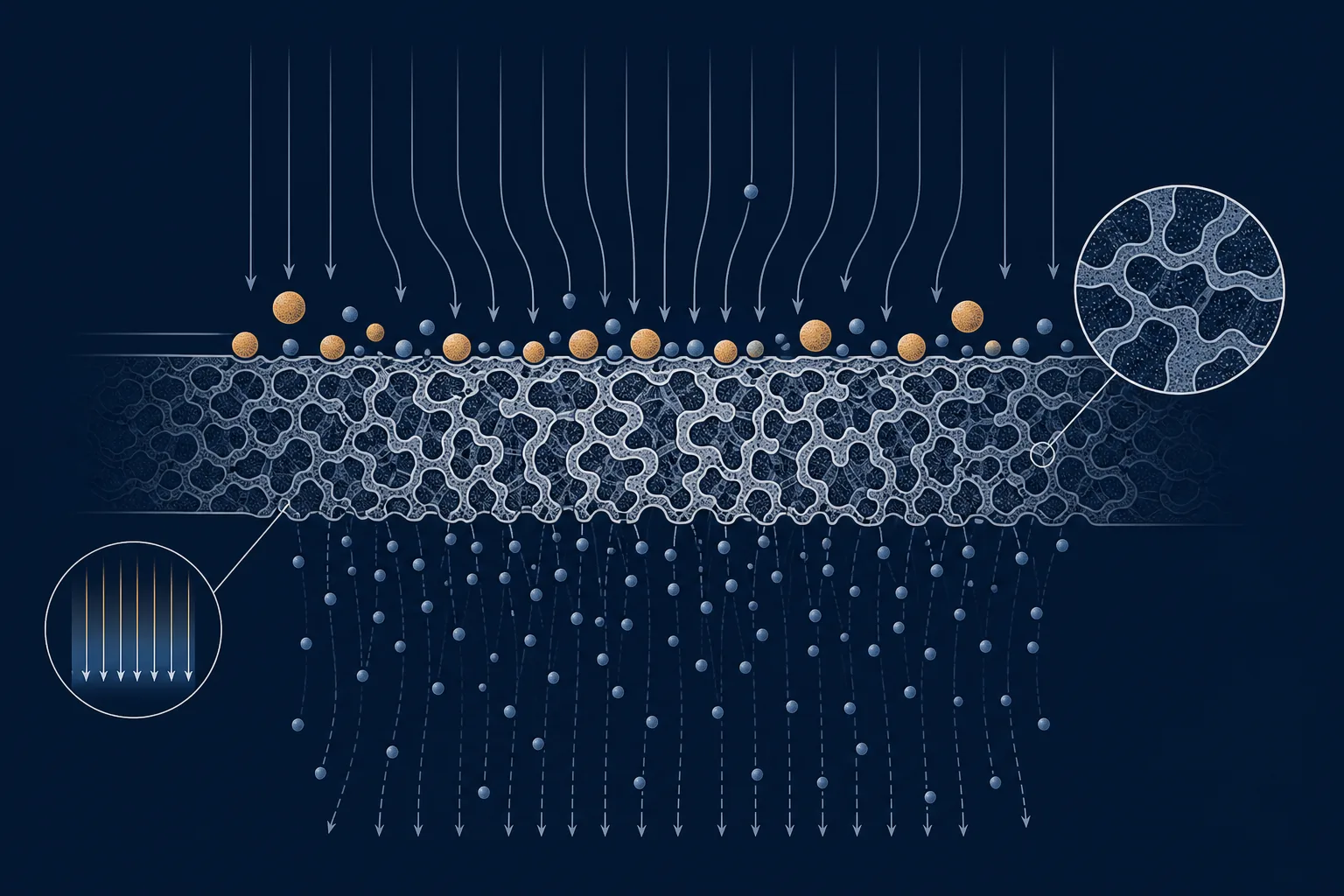
Which membrane suits which solution
The choice is made through two decision filters in sequence: chemical compatibility with the solvent first, adsorption of the substance second. The order matters, because an incompatible membrane does not fail discreetly — it swells, releases extractables that show up as peaks in the chromatogram or, at worst, collapses under pressure. The filter housing, usually polypropylene, is subject to the same compatibility check as the membrane; it is not inert simply because it is plastic.
| Membrane | Compatibility | Protein/peptide adsorption | Typical use |
|---|---|---|---|
| PES (polyethersulfone) | Aqueous solutions, mild organics | Low | Aqueous solutions where recovery is the priority |
| PVDF (polyvinylidene fluoride) | Aqueous and mixed aqueous–organic | Low | General purpose, samples destined for HPLC |
| Cellulose acetate (CA) | Aqueous, limited in organics | Low | Aqueous buffers |
| Regenerated cellulose (RC) | Broad, aqueous and organic | Low | When the same sample changes solvent |
| Nylon | Resistant to organic solvents | High | Organic solutions with no peptide present |
| PTFE | Aggressive organic solvents, gases | Low | Hydrophobic: aqueous samples need prewetting |
| Glass fibre (prefilter) | Broad | Variable | Only as a prefilter for turbid solutions |
After material comes geometry, and here the criterion is volume: 13 mm for samples of a few millilitres, 25 mm for tens of millilitres, 33 mm for larger volumes or for solutions whose particulate load would blind a smaller area. Every device has a hold-up volume — the dead volume that stays inside it and is never recovered. For a one-millilitre sample, a few tens of microlitres is a loss visible in the result. The figure is stated in the technical datasheet; it is one of the few numbers given, and usually one of the few not read.
- Solvent compatibility with the membrane and with the housing, not the membrane alone.
- Hydrophilic or hydrophobic membrane: a hydrophobic one will not wet with an aqueous solution unless prewetted with alcohol, and a "blocked" membrane is often simply an unwetted one.
- Diameter matched to volume and particulate load; a prefilter when the solution is turbid.
- Stated hold-up volume, compared against your sample volume before purchase.
- Sterile or non-sterile: "sterile" describes the packaged device, not your solution.
- A low-extractables statement when the filtrate goes to a chromatograph.
- A lot number on the packaging, so an anomalous chromatogram can be attributed or ruled out.
Peptide lost on the membrane: the error you cannot see
Commercial "low protein binding" claims almost always derive from tests with high molecular weight models, typically albumin or immunoglobulin. Small synthetic peptides do not behave like those, and the fraction of peptide a membrane keeps rather than passes is a property of the polymer surface, not of the pore rating. The systematic work of Goebel-Stengel and colleagues, which measured recovery of labelled peptides across different plastic and glass vessels and different solvents, concludes that loss depends strongly on the peptide, the material and the solution composition, and that the only reliable way to be sure is to determine the combination you use experimentally rather than infer it from a catalogue [4].
The check is cheap and takes an afternoon: the same solution, measured unfiltered and filtered, on the same instrument, with the difference recorded as a percentage. Two practices reduce the loss once it is shown to be real — discarding the first fraction of filtrate so the membrane is already saturated when the measured sample is collected, and choosing a device with a smaller area. Both belong in the notebook alongside the membrane material and lot, otherwise the next divergent result will be uninterpretable.
Syringes: material, dead volume and silicone
ISO 7886-1 sets requirements and test methods for empty sterile single-use plastic syringes, and two of its points are rarely read: these syringes are intended for use immediately after filling and are not intended to contain material for extended periods, while glass syringes and insulin syringes are explicitly excluded and covered by other standards [6]. In other words, the plastic syringe is a transfer tool, not a storage vessel. A solution left in one overnight has been in contact with polypropylene, an elastomeric plunger tip and a lubricant, none of which was designed for that.
The lubricant is the least visible problem. Plungers slide thanks to silicone oil, which transfers into the solution as an emulsion. Jones, Kaufmann and Middaugh showed that the presence of 0.5% silicone oil induced aggregation in four proteins of differing molecular weight and isoelectric point — that is, the effect is a property of the interface rather than of one protein [5]. Interfacial contact sits alongside temperature, concentration and pH among the routes by which peptide comes out of solution, and it is the one a syringe adds for free. For samples headed to chromatography or to particle counting, silicone-free syringes and glass syringes with PTFE plungers exist for exactly this reason, and cost less than repeating the analysis.
- A Luer-Lock fitting rather than a plain taper when filtration follows: the back-pressure of a 0.22 µm membrane can push a slip fitting apart under load.
- Nominal volume close to the sample volume — graduation accuracy is worst at the bottom of the scale.
- Steady, slow pressure on the plunger; sudden force stresses the membrane and can breach it with no visible sign.
- Single use means single use: the standard covers empty single-use syringes and no reuse procedure is covered by it [6].
- Solutions to be kept go into a suitable vial immediately after handling, never left standing in the syringe.
Rubber vial closures: piercing, fragments, sealing
ISO 8362-2 specifies the shape, dimensions, material, performance requirements and labelling of closures for injection vials in that series, and those closures are intended for single use only; the dimensional requirements do not apply to barrier-coated closures, which form a separate category [7]. In practice the two neck sizes you will meet are 13 mm and 20 mm, and the main distinction in form is between solid closures and slotted lyophilisation closures designed to sit half-inserted during drying. A lyophilisation closure in the wrong position does not seal, and the aluminium crimp over it does not correct geometry — it locks it in.
What a rubber closure has to withstand is set out in general chapter 3.2.9 of the European Pharmacopoeia, revised and in force since 1 April 2023, with the pyrogen test replaced by the bacterial endotoxins test [8]. There are three physical tests, and they are instructive even for someone who will never run them: penetrability, fragmentation and self-sealability. The figures below are the chapter's own and are worth verifying against the edition in force, but their order of magnitude has not changed in decades.
| Test | What it checks | Conditions and limit |
|---|---|---|
| Penetrability | Whether the needle passes without excessive force | Needle of 0.8 mm external diameter with a long bevel of 12 ± 2°; piercing force not greater than 10 N per closure |
| Fragmentation | How much rubber is cut away and falls in | 12 closures, 4 punctures each at a different site, a new needle per closure; no more than 5 visible fragments in total |
| Self-sealability | Whether the hole closes after repeated piercing | 10 closures × 10 punctures, immersion in methylene blue, external pressure reduced by 27 kPa for 10 min then 30 min immersed; no coloured solution enters |
| Residue on evaporation | How much material extracts into water | From 50.0 mL of test solution: not more than 2.0 mg for type I rubber and 4.0 mg for type II |
| Extractable zinc | Release of metallic additives | At most 5 micrograms of Zn per millilitre of test solution |
| Heavy metals and ammonium | Contaminants from the rubber formulation | At most 2 ppm each |
The fragmentation test also describes the limit of real practice. The chapter tests four punctures per closure, each at a different site, with a fresh needle per closure and an explicit requirement that the needle must not have been blunted [8]. Anything beyond that — dozens of punctures at the same site with an already-used needle — falls outside anything that was ever validated. How much the tool matters shows in bench data: comparing blunt and sharp needles on vial closures, rubber was cored from 102 of 250 vials (40.8%) with the blunt needle against 9 of 215 (4.2%) with the sharp one [9]. That study concerns a different setting and different materials, but the order of magnitude shows that angle, edge and puncture site are not details.
What 0.22 µm filtration does not do
The list of limits is more useful than the list of capabilities. Mycoplasmas, bacteria without a cell wall and with a pliable membrane, pass through membranes rated at 0.2 and 0.22 µm; retention of Acholeplasma laidlawii, the model organism for 0.1 µm membranes, has been shown to be sensitive even to the cultivation medium and the filtration temperature [10]. Bacterial endotoxins are molecules, not cells, and are not retained; establishing that a preparation is low in endotoxin takes its own test, exactly as it does for rubber closures [8]. And the obvious point that gets forgotten: the filter acts on the liquid, not on the container — a rubber fragment that drops into the vial during piercing is introduced downstream of every membrane.
Documentation and the regulatory frame in the EU and Greece
The category a consumable falls into determines the paperwork that comes with it. Regulation (EU) 2017/745 on medical devices, applicable since 26 May 2021, covers products intended for medical use in humans — that is where CE-marked sterile syringes sit [11]. A consumable labelled "for laboratory use" falls outside that scope: it carries no CE marking as a medical device, has no notified body, and is not entered in the medical device registry maintained by EOF, the Greek national authority. That does not make it inferior; it makes it a different thing, and the mistake is made when one identity is invoked to cover the other.
- Lot number and catalogue code for every type of consumable, recorded in the notebook with the experiment, not only on the invoice.
- The manufacturer's sterility statement or certificate for consumables received sterile, with the treatment method declared.
- A datasheet giving membrane material, diameter, hold-up volume and declared extractables — filed, not merely read.
- Expiry date where one exists: for sterile consumables it applies to the sealed pack, and a torn pack voids the statement whatever the date.
- A change of supplier or membrane type logged as an event, with the recovery check repeated before old and new results are compared.
Where the documentation is genuinely weak, since that should be said too: there are no published inter-laboratory recovery data for specific research peptides through specific membrane types, and manufacturers' low-binding claims rest on models that do not resemble small synthetic peptides [4]. Nor is there a standard covering syringe filters as laboratory consumables the way ISO 7886-1 covers syringes or ISO 8362-2 covers closures: the ASTM F838 test addresses the membrane, not the device in your hand [1][6][7]. That gap is not closed by buying better, it is closed by your own recovery check and by consistency in the material you choose.
References
- ASTM F838-20 — Standard Test Method for Determining Bacterial Retention of Membrane Filters Utilized for Liquid FiltrationASTM International, 2020
- ASTM F316-03(2019) — Standard Test Methods for Pore Size Characteristics of Membrane Filters by Bubble Point and Mean Flow Pore TestASTM International, 2019
- Guideline on the sterilisation of the medicinal product, active substance, excipient and primary container (EMA/CHMP/CVMP/QWP/850374/2015)European Medicines Agency, Committee for Medicinal Products for Human Use / Committee for Medicinal Products for Veterinary Use, 2019
- The importance of using the optimal plasticware and glassware in studies involving peptidesAnalytical Biochemistry, 414(1):38–46 (PMID 21315060), 2011
- Silicone oil induced aggregation of proteinsJournal of Pharmaceutical Sciences, 94(4):918–927 (PMID 15736189), 2005
- ISO 7886-1:2017 — Sterile hypodermic syringes for single use — Part 1: Syringes for manual useInternational Organization for Standardization, 2017
- ISO 8362-2:2024 — Injection containers and accessories — Part 2: Closures for injection vialsInternational Organization for Standardization, 2024
- Ph. Eur. general chapter 3.2.9 — Rubber closures for containers for aqueous parenteral preparations, for powders and for freeze-dried powders (revised text, Supplement 11.1)European Directorate for the Quality of Medicines & HealthCare (EDQM), Council of Europe, 2023
- The incidence of coring with blunt versus sharp needlesJournal of Clinical Anesthesia, 26(2):152–154 (PMID 24582180), 2014
- Retention of Acholeplasma laidlawii by Sterile Filtration Membranes: Effect of Cultivation Medium and Filtration TemperaturePDA Journal of Pharmaceutical Science and Technology, 72(3):264–277 (PMID 29343618), 2018
- Regulation (EU) 2017/745 on medical devices, amending Directive 2001/83/EC, Regulation (EC) No 178/2002 and Regulation (EC) No 1223/2009European Parliament and Council of the European Union (EUR-Lex), 2017