Procurement for Greek university laboratories through ELKE: procedure, thresholds, invoice and payment
How a Greek academic laboratory buys from an ELKE project: the principal investigator's market research, the direct-award decision, the €10,000 and €30,000 thresholds, the electronic invoice and the payment deadlines.
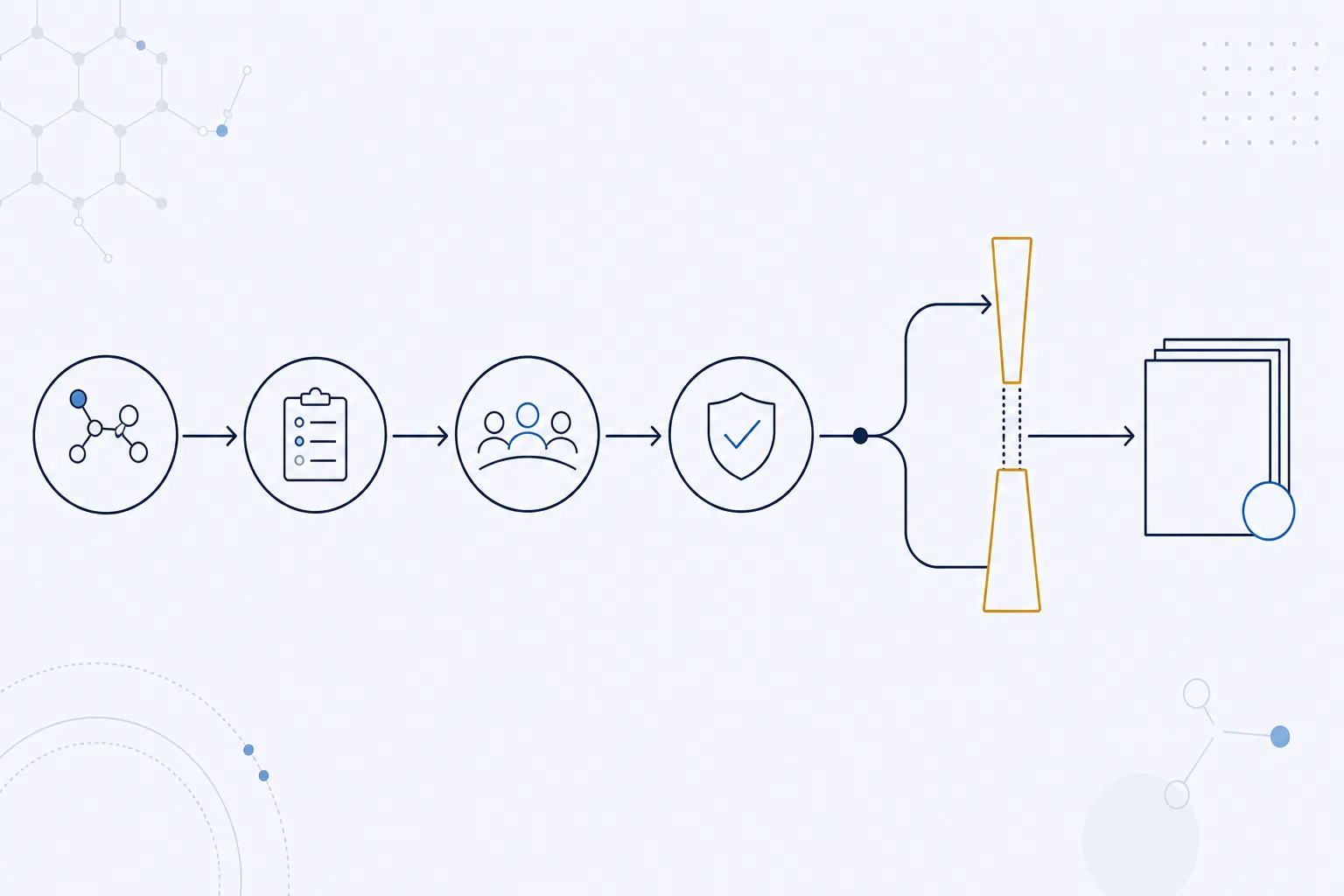
A Greek university laboratory does not buy on its own signature. It buys through the institution's Special Account for Research Funds (ELKE), which manages research project funds under Articles 229 onwards of Law 4957/2022 [1]. For routine purchases the procedure is direct award: the project's principal investigator carries out market research and collects quotes, ELKE's services check the file, the President of the Research Committee signs a direct-award decision that is posted on Diavgeia, and after delivery the supplier issues an electronic invoice that is then paid [3] [7]. The ceiling for direct award is €30,000 excluding VAT [2] [3].
The article is written for both sides: the researcher who has to build a correct request, and the supplier who wants to be paid without the invoice being sent back. Details differ between institutions; the examples come from published ELKE guidance and should always be checked against your own institution's instructions.
How a Greek academic laboratory buys
Every higher education institution operates an ELKE to manage research funds [1]. ELKE is not the buyer in the commercial sense: it is the body that takes on the commitment, checks lawfulness and pays. The principal investigator (PI) of each project is the person who knows what the laboratory needs, and the supplier deals with them. But the request is completed only after it has passed through ELKE's services and the Research Committee or its President, depending on the decision required [1].
For the supplier, this means that a verbal agreement with a researcher is not an order. There is an order when there is a direct-award decision or, for larger amounts, a signed contract. Shipping material before that point is at the supplier's own risk.
Direct award: steps and thresholds
Article 118 of Law 4412/2016, as replaced in 2021, allows direct award where the estimated value of the contract is equal to or less than €30,000 excluding VAT [2]. For ELKE projects, Article 250 of Law 4957/2022 simplifies the procedure: market research is satisfied by one quote for smaller amounts and by two above €10,000 [1]. As Aristotle University's ELKE describes it, the steps are [3]:
- Market research by the PI: collecting quotes through documents, the internet or email, with a technical description and price [3].
- Choice of contractor and submission of the request: one quote up to €10,000, at least two from €10,000.01 to €30,000 [3].
- Administrative check by ELKE's services for completeness and lawfulness of the file [3].
- Direct-award decision by the President of the Research Committee, posted on Diavgeia [3].
- A written contract where the amount exceeds €10,000; below that the contract is concluded when the award is notified [1] [4].
- Delivery, receipt confirmation, invoice and payment request by the PI [3].
Two simplifications in the law bear directly on suppliers. For direct awards on ELKE projects no call has to be posted on KIMDIS, the central public procurement register, and for foreign contractors up to €30,000 tax and social-security clearance certificates are not required, as the Agricultural University of Athens' ELKE summarises [4].
What a quote needs in order to be used
The quote is the first document in the file and is read by someone who is not a chemist. It has to stand without explanation:
- Addressed to the institution's ELKE, referring to the PI and, where known, the project code.
- A description of each item that will later match the invoice and delivery note word for word.
- Price excluding VAT, VAT and total, so it is immediately clear which threshold the contract falls under [2].
- Quote validity and delivery time; approval takes time, and a quote that expires in a week often has to be reissued.
- Shipping terms and who bears the cost and risk of transport.
What an invoice needs in order to be accepted
Since 1 June 2024, for award procedures started after that date, suppliers on ELKE projects issue electronic invoices under Articles 148 to 154 of Law 4601/2019, through a certified provider [7]. The University of Ioannina's ELKE, for example, requires the invoice to carry the contracting authority code, the project code, the ADA number of the budget commitment, and the ADAM reference of the contract or "0" where there is none [7]. An invoice without a project code cannot be matched to the budget and is returned.
Where the supplier is established in another Member State, the VAT rules on intra-Community acquisitions apply on top, and we explain them separately. How a foreign supplier without a Greek tax number submits an electronic invoice is set out in each ELKE's instructions and is worth checking before the award, not after delivery.
Receipt and payment periods
At Aristotle University, for purchases between €2,500 and €30,000, receipt is confirmed by the PI in a written confirmation, without a separate committee report [3]. That confirmation proves that what was ordered was delivered; it does not replace the batch traceability record the laboratory keeps for the material itself.
Payment is governed by Law 4152/2013, which transposed Directive 2011/7/EU on late payment [5] [6]. In transactions between businesses and public authorities the payment period normally does not exceed 30 calendar days. Where an acceptance or verification procedure applies, it may not exceed 30 days from receipt unless the contract provides otherwise. A longer period, up to 60 days, is allowed only if explicitly agreed and objectively justified [5].
| Cause | Where it shows | Who fixes it |
|---|---|---|
| Missing project code or ADA | On the electronic invoice | The supplier, with a new document |
| Invoice description differs from the quote | In ELKE's check | The supplier or the PI, before submission |
| No receipt confirmation issued | In the payment file | The PI |
| Invoice issued before the award decision | In the dates on the file | Nobody easily; avoided only by the right sequence |
Documenting the research purpose
Every ELKE expense is charged to a specific project, and the PI is the person who confirms that the material serves the project's subject [1]. For research reagents that means a short justification linking the item to the project's methodology, not general wording. Where the material is supplied under a research-use designation, the justification must be consistent with it; it helps if the author knows what the "research use only" label means in practice, so as not to read more into it than it states.
Some suppliers additionally ask the recipient for a written declaration of research purpose. That is a separate act with its own responsibility, and we deal with it in a separate article. Here it is enough to note that it does not replace the award decision or the PI's justification; it is added to them.
References
- Νόμος 4957/2022 «Νέοι Ορίζοντες στα Ανώτατα Εκπαιδευτικά Ιδρύματα: Ενίσχυση της ποιότητας, της λειτουργικότητας και της σύνδεσης των Α.Ε.Ι. με την κοινωνία και λοιπές διατάξεις» (ΦΕΚ Α΄ 141/21.7.2022)Ελληνική Δημοκρατία, Εφημερίς της Κυβερνήσεως (κωδικοποιημένο κείμενο, Kodiko.gr), 2022
- Νόμος 4412/2016 «Δημόσιες Συμβάσεις Έργων, Προμηθειών και Υπηρεσιών» — κείμενο του νόμουΕνιαία Ανεξάρτητη Αρχή Δημοσίων Συμβάσεων (ΕΑΑΔΗΣΥ), 2016
- Απευθείας Ανάθεση — ΠρομήθειεςΕΛΚΕ — Επιτροπή Ερευνών, Αριστοτέλειο Πανεπιστήμιο Θεσσαλονίκης
- Νέες διαδικασίες προμηθειών βάσει του ν. 4957/2022ΕΛΚΕ — Γεωπονικό Πανεπιστήμιο Αθηνών, 2022
- Νόμος 4152/2013, άρθρο πρώτο παρ. Ζ.5 — Συναλλαγές μεταξύ επιχειρήσεων και δημοσίων αρχών (άρθρο 4 της Οδηγίας 2011/7/ΕΕ)Lawspot — Νομοθεσία, 2013
- Directive 2011/7/EU of the European Parliament and of the Council of 16 February 2011 on combating late payment in commercial transactionsOfficial Journal of the European Union (EUR-Lex), 2011
- Υποχρέωση έκδοσης ηλεκτρονικών τιμολογίων από προμηθευτές αγαθών ή υπηρεσιών στο πλαίσιο έργων του Ε.Λ.Κ.Ε. του Πανεπιστημίου ΙωαννίνωνΕπιτροπή Ερευνών, Πανεπιστήμιο Ιωαννίνων, 2024