
Keeping laboratory records: the minimum requirements for receipt, batch and storage
Which fields to record for every receipt of research material, how the batch number is tied to its documents, how long records are kept, and a minimum register template you can copy.
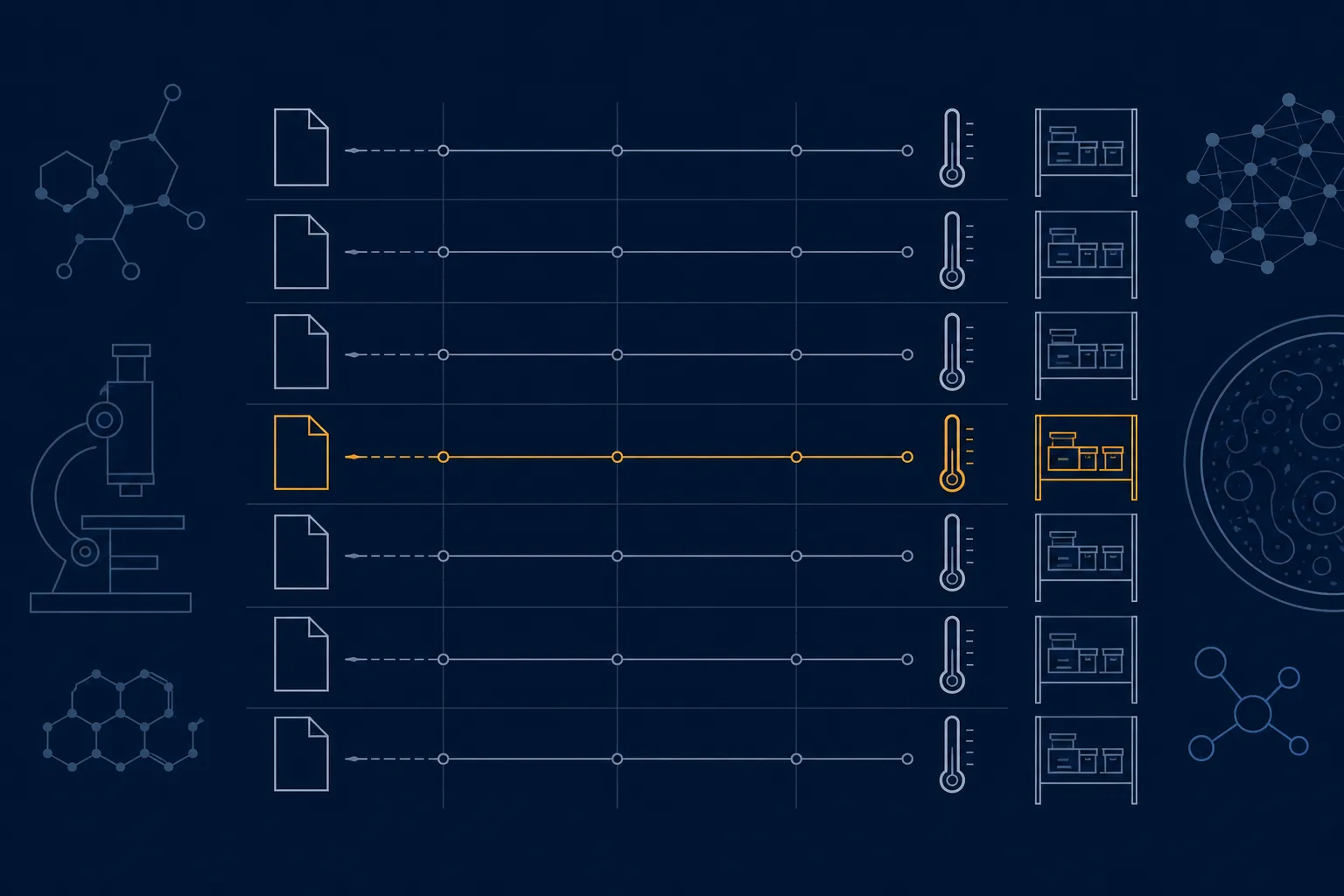
The minimum record is a register with one line per receipt. The line links three things: what was received (identity, batch number, quantity, condition on arrival), with which documents (invoice, certificate of analysis, safety data sheet), and where and how it is stored. Every entry carries a date and the name of the person who made it, is made at the time of the event, and is kept for a defined period. That is the floor, and whatever framework you work under it cannot be lower.
The goods-in check, meaning what you look at when you open the parcel, and the labelling of aliquots each have their own articles. This one is about the register that holds them together, so that months later the question "which batch did this result come from, and what state was the material in?" can be answered without anyone having to tell the story.
What to record on receipt
ISO/IEC 17025 requires laboratories to keep technical records with enough information that, where possible, the factors affecting a result can be identified and the activity repeated under conditions as close as possible to the original [1]. The OECD Principles of Good Laboratory Practice require, for every test and reference item, a record of receipt and storage conditions, with an identifier and batch details [2]. Even a laboratory bound by neither gains from that logic. On receipt, record:
- An internal receipt number, unique, to be written on every document and label of the same receipt.
- Date and time of arrival, and the name of the person who received it [3].
- Supplier, order number and invoice number.
- Product description and code as on the invoice, and the batch number as on the label.
- Quantity received, counted in units, not only as stated on the delivery note.
- Condition on arrival: integrity of packaging and seals, temperature indicator where present, remarks.
- Decision: accepted, accepted with a remark, or quarantined pending clarification.
Linking the batch to its documents
The batch number is the only item that appears at once on the vial, on the certificate of analysis and, usually, on the delivery note. The register's job is to record that the three numbers were checked and match, and to show where each document is. If the number on the certificate does not match the label, that goes on the receipt line, not on a note that gets lost.
REACH adds a reason that applies to every professional user of chemical substances, not only accredited laboratories. Article 36 requires every manufacturer, importer, downstream user and distributor to assemble and keep available all the information needed for their duties under the Regulation for at least ten years after they last manufactured, imported, supplied or used the substance [4]. The safety data sheet, or the Article 32 information that came with a receipt, is part of that information, and the register is how it is found.
Recording storage conditions
A result from material that was stored wrongly is not reliable, and without a record nobody can rule that out. The register does not need to hold the temperature readings themselves. It needs to show which unit each batch is stored in and to point to that unit's monitoring record [2].
- Storage location: unit, shelf or box, with a code that corresponds to a temperature record.
- Date of first opening or reconstitution, and who did it.
- Every move to another unit, with its date.
- Every temperature excursion affecting the unit, with a reference to its assessment.
- Final disposition: used up, discarded or returned, with its date.
How long records are kept
There is no single period for every laboratory. There are overlapping rules, and the strictest of those that apply to you governs:
| Rule | What it covers | Duration |
|---|---|---|
| REACH, Article 36 | Information you need for your duties as a user of chemical substances | At least ten years from last manufacture, import, supply or use |
| Code of Tax Procedure | Accounting records and supporting documents, such as invoices | Ten years from the end of the tax year |
| ISO/IEC 17025 | Technical records of an accredited laboratory | As the laboratory itself defines, in line with contractual and legal obligations |
| OECD Principles of Good Laboratory Practice | Records of studies falling under them | As the competent authorities specify |
| Funder or institutional terms | Research project records | As the funding agreement specifies |
The ten years under the Code of Tax Procedure concern tax documents [5]; the ten years under REACH run from the last use of the substance, not from receipt [4]. For a material used over several years, the second expires later. ISO/IEC 17025 leaves the laboratory to set the duration, but requires it to be set and documented [1].
Paper or electronic records
Both are acceptable. What is judged is data integrity. The MHRA data integrity guidance sums up the requirements in the acronym ALCOA: records must be attributable, legible, contemporaneous, original and accurate, and must remain complete, consistent, enduring and available throughout their life cycle [3]. The same logic of immediate recording applies to the working notebook, for which it is worth reading the laboratory notebook and contemporaneous records.
| Requirement | Paper register | Electronic register |
|---|---|---|
| Attributable | Name and signature on every entry | Individual accounts, not a shared login |
| Correction without obliteration | One line through the error, correct value beside it, initials and date | An audit trail keeping the original value, the new one, who and when |
| Protection against loss | Bound book with numbered pages, kept away from the bench | Backups at another location, with a tested restore |
| Legible over time | Indelible ink | A file format that will still open in ten years |
The hybrid system, with paper entries scanned to a network folder, is the commonest and the most fragile. If the scan is the record, it must be checked for completeness and legibility. If the paper is the record, it must be kept as a record [3].
A minimum register template
The template below is one line of the register, written vertically for readability. In a spreadsheet each field is one column. It is the minimum administrative register; anyone who wants to follow the material through preparations and dilutions also needs the technical side of batch traceability.
| Field | What is written | Example |
|---|---|---|
| Receipt no. | Unique internal number | ΠΡ-2026-014 |
| Date, time, received by | At the moment of arrival | 15/09/2026, 10:40, A. Papadopoulou |
| Supplier, order, invoice | As on the documents | Supplier X, order 5521, invoice 0932 |
| Material and code | Description as on the invoice | Lyophilised peptide, code P-118 |
| Batch no. | As on the label | L2608-03 |
| Match check | Label, certificate, delivery note | All three match |
| Quantity | Counted on receipt | 5 vials |
| Condition on arrival | Packaging, seals, temperature | Intact, cold-chain indicator within limits |
| Documents and location | Certificate, safety data sheet, invoice | File ΠΡ-2026-014 |
| Decision | Accepted, remark or quarantine | Accepted |
| Storage location | Unit and box | Freezer K2, box 4 |
| First opened | Date and person | 22/09/2026, G. Nikolaou |
| Final disposition | Used up, discarded or returned | Completed at the end |
Thirteen fields are fewer than they look: most are copied from documents you already have. What is copied from nowhere, and the only part that really earns the time, is the match check and the decision. That is where the register stops being a list and becomes a record [1] [3].
References
- ISO/IEC 17025:2017 — General requirements for the competence of testing and calibration laboratoriesInternational Organization for Standardization / International Electrotechnical Commission, 2017
- OECD Principles on Good Laboratory Practice (as revised in 1997), ENV/MC/CHEM(98)17Organisation for Economic Co-operation and Development (OECD), 1998
- 'GXP' Data Integrity Guidance and Definitions, Revision 1Medicines and Healthcare products Regulatory Agency (MHRA), 2018
- Regulation (EC) No 1907/2006 concerning the Registration, Evaluation, Authorisation and Restriction of Chemicals (REACH)Official Journal of the European Union (EUR-Lex), 2006
- Νόμος 5104/2024 «Κώδικας Φορολογικής Διαδικασίας» (ΦΕΚ Α΄ 58/19.04.2024)Ανεξάρτητη Αρχή Δημοσίων Εσόδων (ΑΑΔΕ) — Ηλεκτρονική Βιβλιοθήκη, 2024