
Card, IRIS, bank transfer or cash on delivery: what protects the buyer
Four ways to pay, one criterion: what recourse and what paper trail you keep when an order of research materials does not go as it should.
Which payment method leaves a buyer of research materials the most recourse if something goes wrong?
Payment is the point in a purchase where the decision becomes irreversible or does not. Of the four methods a buyer meets in Greece, the card leaves the most recourse, because a third party, the issuing bank, can examine the dispute. IRIS and bank transfer are payment orders that the payer authorises personally, and they have no published dispute mechanism equivalent to the card's. Cash on delivery leaves control at the door, but not the right to open the parcel and inspect what is inside.
This article compares the four methods on a single criterion: what the buyer is left with when an order does not arrive, arrives different, or is contested. It does not judge suppliers or particular shops. Where a practice depends on the terms of your bank or courier, we say so and send you to the terms document, not to a guess.
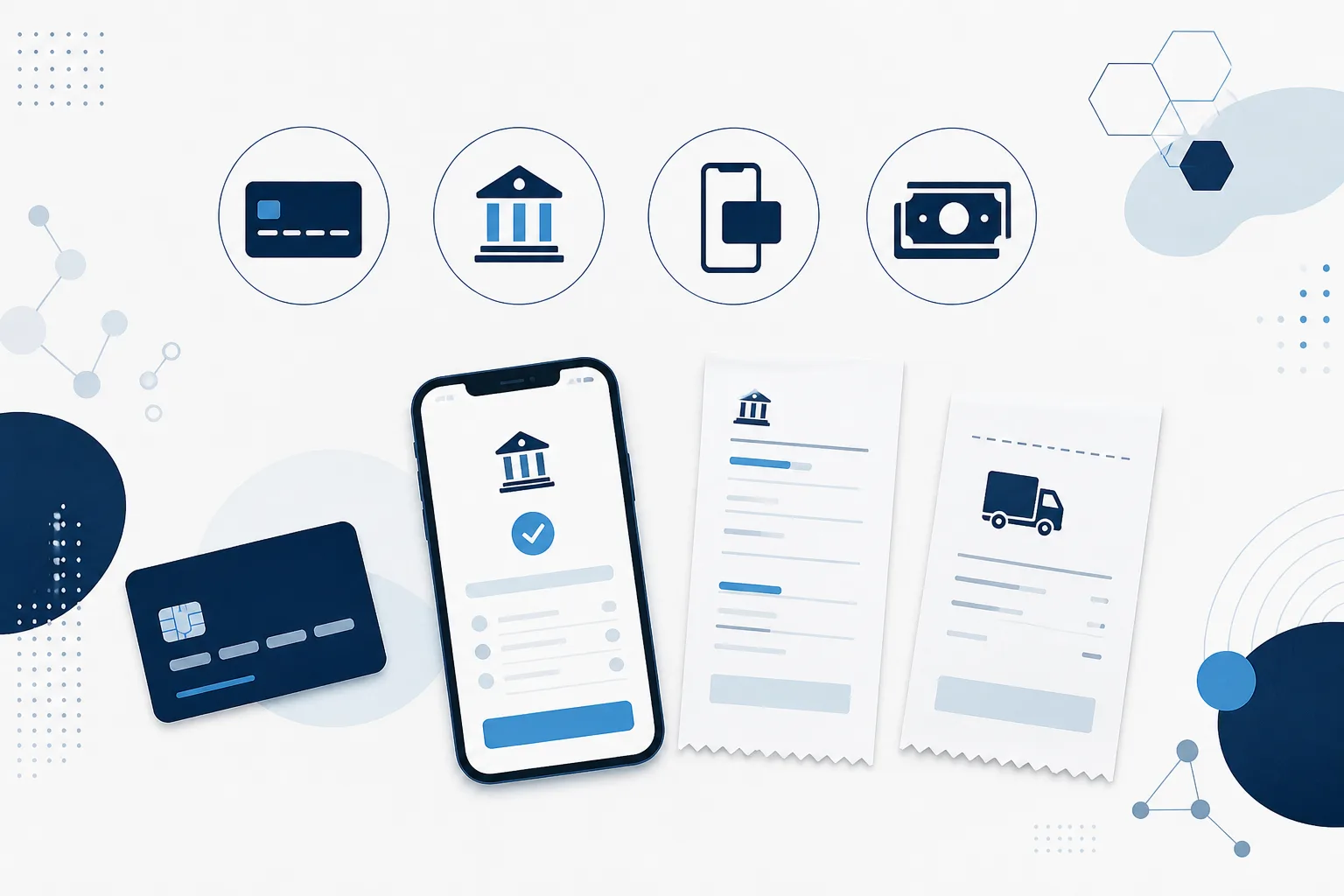
One criterion: the recourse you keep
A payment can go wrong in three ways. The charge was not made by you. The charge was made by you but the material was not delivered. The material was delivered but does not match what was agreed. The three have different legal bases, and each payment method covers them differently.
That is why the comparison does not ask which method is «safest» in the abstract. It asks which third party steps in, by what deadline and with what documents. There is no published, independent statistic on how often disputes succeed per method in Greece; what follows describes mechanisms, not odds of success.
The capacity in which you buy also matters. Directive 2011/83/EU on consumer rights concerns consumers [5]. A laboratory, a university or a company buying for professional use often falls outside it, and the relationship with the seller is governed mainly by the contract and the sales terms. PSD2 also allows different terms to be agreed for some of its protective provisions when the payment service user is not a consumer [2].
The practical consequence is simple: before ordering, read the terms of the card or account you will use and note which deadlines and documents the bank requires. If you pay from a company or institutional account, ask the finance officer for the terms and keep a copy in the same folder as the order.
Card: strong authentication and disputes
Online card payments in the EU are subject to strong customer authentication, known in practice as 3D Secure. Delegated Regulation 2018/389 provides that it rests on two or more elements from the knowledge, possession and inherence categories, and that the code is bound to the amount and the payee, so that any change to either invalidates it [3]. The PSD2 framework itself sets what happens when a transaction was not authorised by the holder: the payment service provider must refund the amount immediately, with the payer's liability limited except in cases of fraud or gross negligence [2].
The distinction that is often lost is that PSD2 concerns the unauthorised transaction. If you approved the payment and the material did not arrive, it is a commercial dispute. The issuing bank examines it under the rules of the card network and its own policy, with deadlines and evidence that it sets. The article on disputing a card transaction walks through the procedure. Keep one conclusion here: the card gives you a route, not a guarantee.
IRIS: an instant transfer, a trail at the bank
IRIS runs on the SEPA Instant Credit Transfer scheme. DIAS states that funds are credited to the payee within 10 seconds, around the clock, and that in IRIS Commerce the merchant starts the payment and the payer approves it in their bank's e-banking or mobile banking app [1]. No card and no IBAN entry are needed.
What the same page does not state is a refund or dispute procedure [1]. A transfer you approved yourself is not an unauthorised one, so the PSD2 fraud protections do not apply automatically to a disagreement about delivery. The advantage of IRIS is that it leaves a trail in your bank history with exact time, amount and payee. Recovery has to be requested from the seller. Before using IRIS for a purchase from a seller you do not yet trust, ask your bank in writing what it provides for disputes.
Bank transfer: the most irreversible option
A transfer is an order you give to a specific IBAN. There is no third party examining the transaction and no intermediary holding the funds. If the payee does not cooperate, recovery goes through the payee, from bank to bank, or through the courts.
The second risk is the IBAN itself. A change of bank details on an invoice or an email, without confirmation through a second channel, is the classic point where money is lost. Before any first transfer to a new supplier, verify the IBAN by phone on a number you found yourself, and compare the payee name your bank displays with the name on the invoice.
Cash on delivery: control before paying, not always of the contents
With cash on delivery you pay the courier when you receive the parcel. Legally, the courier collects on the seller's behalf, and the contract is between the seller and the courier. In the regulation governing postal-service complaints, the postal regulator (EETT) states expressly that it has no competence over customs clearance, cash-on-delivery collections and unfair competition [4]. A cash-on-delivery dispute therefore has no regulatory route to EETT.
Whether you may open the parcel before paying depends on the courier's terms, and we did not confirm it for any particular courier. Read the terms or ask the seller before ordering. Under Directive 2011/83/EU, the total cost, including any additional delivery or payment charges, must be disclosed before you are bound [5]: if cash on delivery carries a fee, you must see it before the order.
| Method | Who approves | Which third party can help | What evidence remains |
|---|---|---|---|
| Card | You, with strong authentication | Issuing bank (dispute) | Statement entry, transaction number |
| IRIS | You, in your bank's app | Your bank, with no published dispute procedure | History entry with time and payee |
| Bank transfer | You, with an order to an IBAN | No one at mechanism level; only the payee | Order and bank confirmation |
| Cash on delivery | You, at the door | The seller and the courier; not EETT for the collection | Courier receipt |
Paperwork and the payment record
Payment does not replace the invoice. Whatever method you choose, the seller issues a document for the purchase, and that is the document your finance office needs. What an invoice must state, and how the tax number and intra-EU acquisition work, is explained in a separate article.
For a dispute, the value of a record is practical. If you keep in one folder a record that ties each payment to a lot number, the bank, the courier and the seller can see from the first contact that you know exactly what you bought and when.
- Order confirmation with an order number and a full description of items, prices and delivery cost.
- Proof of payment: card statement, IRIS history, transfer order or cash-on-delivery receipt.
- Invoice or document with the seller's tax number and details.
- Tracking number and the courier's proof of delivery.
- All written communication with the seller, with dates.
What to check before paying
Choose the payment method as a decision about recourse, not convenience. If the order is large or the seller is new, prefer the method that has a third-party examiner. If a seller insists on a single method with no third party, record that as a risk factor, not as a detail.
Everything described here concerns purchases of materials strictly for research use and their documentation. These materials are not intended for administration to humans or animals. Check your bank's terms for dispute deadlines before your first order, not after.
References
- Υπηρεσία IRIS paymentsΔΙΑΣ – Διατραπεζικά Συστήματα Α.Ε., 2026
- Οδηγία (ΕΕ) 2015/2366 για τις υπηρεσίες πληρωμών στην εσωτερική αγορά (PSD2)EUR-Lex, 2015
- Κατ' εξουσιοδότηση Κανονισμός (ΕΕ) 2018/389 για την ισχυρή ταυτοποίηση πελάτηEUR-Lex, 2018
- Κανονισμός περί διαδικασιών επίλυσης διαφορών και εξέτασης παραπόνων χρηστών ταχυδρομικών υπηρεσιών (ΑΠ 1135/004)ΕΕΤΤ, 2024
- Οδηγία 2011/83/ΕΕ για τα δικαιώματα των καταναλωτώνEUR-Lex, 2011