
Shipping to Greek islands and remote areas: courier delivery times and order planning
Distance does not set the transit time to an island. The ferry does, together with the carrier's network map and whichever weekend happens to fall in the middle.
A courier parcel leaving Attica usually reaches a mainland town in one to two working days, an island in one to three, and an area the carrier classifies as remote in one to five. Those are the ranges ACS publishes for its basic domestic services, counted in working days from departure from Attica [1]. They are honest ranges, but they hide the point that matters: distance does not set the transit time to an island. What sets it is the ferry or flight the parcel has to catch, whether the address sits inside the town limits of the carrier's network, and whether the shipment falls before or after a weekend.
This article covers the domestic leg only, from the dispatching warehouse to your door. What happens when a parcel crosses a border inside the EU is covered in the article on intra-EU shipping, and the Greek summer has its own article in this section. The subject here is geography: how a box reaches Symi, Kythira or a village in the Agrafa mountains, and what that means for when you order.
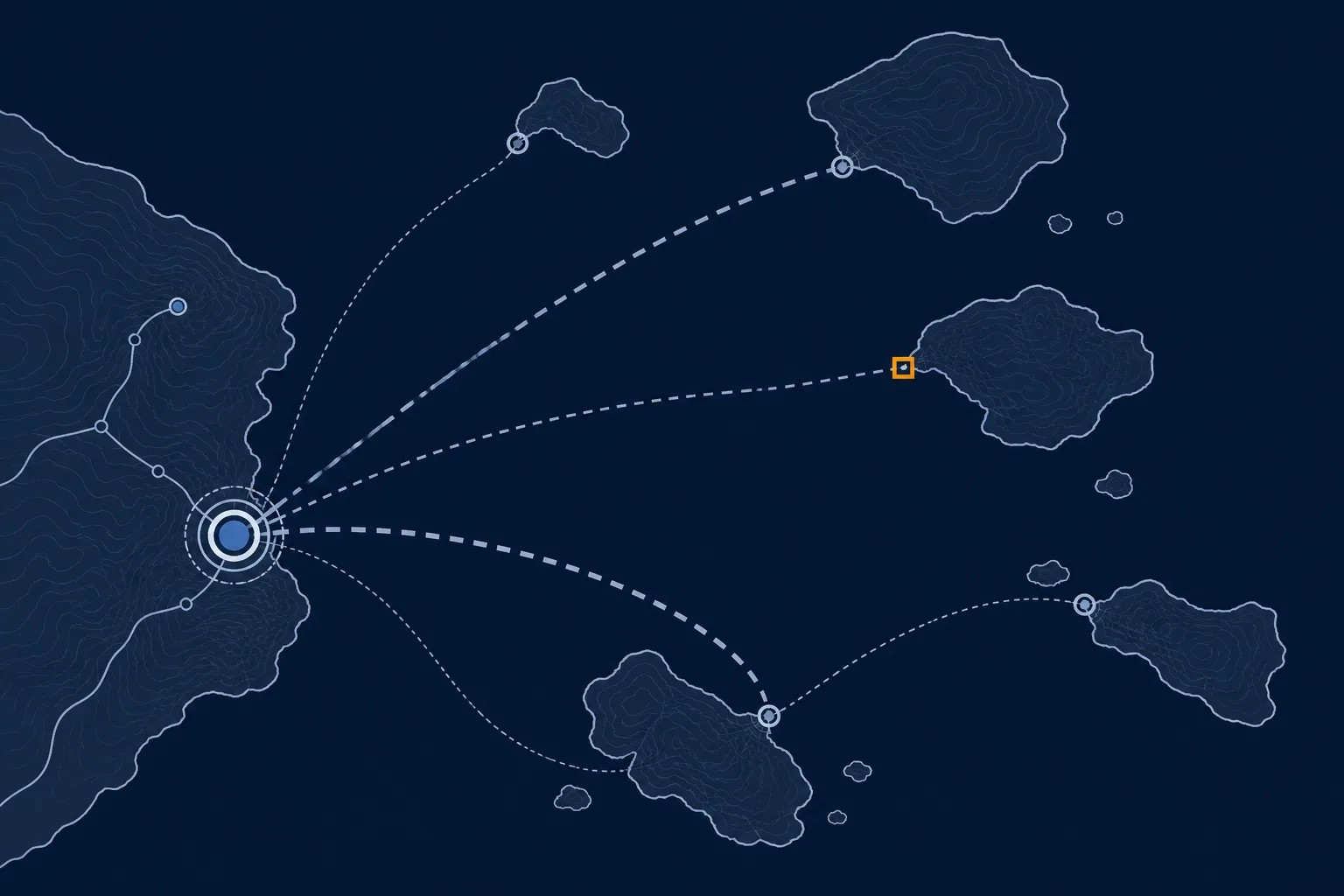
How a parcel is routed to an island
No parcel travels "direct". It always follows the same chain: collection from the sender, a central sorting hub, a line haul to the branch or agent serving the destination, and final delivery. For a mainland destination the line haul is a truck that leaves in the evening and arrives in the morning. For an island, the middle link is a ferry or a flight, and the carrier does not own that link.
Where a carrier has no branch of its own, delivery passes to a third party. ELTA's general terms for domestic courier services say so explicitly: in areas without a courier branch, or in outlying and remote areas, items are handled through partner agents or post offices [2]. Every such handover is a point where the parcel can wait for the next available transport, and a point where the tracking scan can lag behind the parcel's actual movement.
- Dispatching warehouse to hub: decided by collection time. ACS publishes a 16:00 cut-off for parcels, after which departure may move to the next working day, as it may for parcels over two kilograms [1].
- Hub to port or airport: the parcel has to make that day's specific sailing or flight; if it misses it, it waits for the next one, whenever that is.
- Sea or air connection: the only link no carrier controls, and the only one that stops for weather.
- Island branch to address: on small islands and in mountain villages, delivery may run only on certain days of the week, or through an agent [2].
Ferry and air connections: the real constraint
Large islands with many daily connections, such as Crete, Rhodes, Corfu or Lesvos, behave almost like mainland towns. Small islands on routes that run a few times a week in winter behave very differently: a parcel that misses Tuesday's ferry can sit in Piraeus until Friday, and no "next-day" service changes that fact. The route timetable is your real schedule.
Weather is the second factor, and it cannot be forecast to the day. When port authorities ban sailings because of strong winds, parcels stay on the quay along with the passengers. Carriers' terms treat this as force majeure: ELTA's terms expressly exclude from any compensation delays caused by late-running transport not attributable to the company, as well as loss or damage from weather conditions that could not be foreseen [2]. In practice, the day lost to a meltemi or a winter storm is your day, not the carrier's.
An air connection shortens the time, but it has two limits. First, not every network flies parcels to every island, and for many destinations the parcel goes by sea even where there is an airport. Second, anything travelling with dry ice changes status the moment it boards an aircraft, as explained in the article on intra-EU shipping. That is why the right question to the sender is not only "how many days" but also "by which route".
Seasonality: what changes in summer
Summer brings more sailings and more pressure at the same time. Routes run more often, but ferry garages fill with vehicles, island branches handle several times their normal volume with roughly the same staff, and addresses in tourist areas multiply while becoming less precise. The result is that the average transit time does not change dramatically, but the spread widens: more parcels arrive in one day, and more arrive in four. The week of the 15 August holiday combines a public holiday, peak passenger traffic and closed offices, and it is the worst week of the year for anything with a deadline.
Summer is also when time has a thermal cost. At the peak of the July 2026 heatwave, the automatic station network of the National Observatory of Athens recorded a maximum temperature above 43 °C, with 28 stations above 40 °C and 138 stations above 37 °C [4]. An extra day in a port warehouse or a closed truck does not mean the same thing in July as in November. The thermal side is covered in the article on transit temperatures in the Greek summer; here the rule is enough: in summer, every day that geography adds counts twice.
What "remote area" means, and what it costs
"Remote" (δυσπρόσιτη) is not a geographical term; it is a commercial classification that each carrier draws its own way. ACS defines as remote every area outside the town limits of its network [1]. SPEEDEX uses two tiers: outlying areas are those outside town limits within a 40-kilometre radius of the town centre, and remote areas are those beyond that radius [3]. ELTA serves outlying and remote areas through partner agents and post offices, whose network is declared to ΕΕΤΤ, the Greek postal regulator [2].
The consequence is practical: the same village can be a standard destination for one carrier and a remote one for another, with a different transit time and a different charge. Carriers add a surcharge for delivery to remote areas, and the amount is set in their current price lists. We do not quote it here, because it changes. What does not change is how to check: the major carriers offer an area search on their websites, and the check takes a minute.
- Check the postcode in the area-search tool of the carrier that will actually be used, not a different one.
- If the address is remote, find the nearest branch or agent and ask whether collection there is faster than delivery.
- Ask whether a faster remote-area delivery service exists and on what conditions; SPEEDEX, for example, publishes next-working-day delivery to remote areas for land destinations [3].
- Make sure the street and number exist as such. In many island villages they do not, and a mobile number that answers is more useful than the most careful description.
Realistic times by zone
The table starts from the ranges ACS publishes [1] and adds what those ranges do not show: what lengthens the time in each zone, and what you can do about it. A reminder worth repeating: the ranges count working days from departure from Attica, not from the moment you completed the order.
| Destination zone | Published range | What lengthens it | What helps |
|---|---|---|---|
| Attica, within town | 1 working day | Handover to the carrier after the collection cut-off | Completing the order early in the day |
| Mainland town inside the network | 1–2 working days | Passing through a second sorting hub | An address inside town limits, or collection from a branch |
| Island with a daily connection | 1–3 working days | Full ferry garages and summer volume | Dispatch between Monday and Wednesday |
| Small island on an infrequent route | As for islands, but in practice set by the timetable | Connections less than daily, sailing bans | Asking the local branch which days the route runs |
| Remote area | 1–5 working days | Transfer to an agent, delivery on set days only | Collection from the nearest branch |
Two cautions when reading the table. First, the ranges are not guarantees. ELTA's terms describe delivery times per product and destination as quality terms, and provide limited flat-rate compensation only for delay proven to be caused solely by the company [2]. Second, weekends do not count. A parcel leaving on Thursday evening for an island with a three-working-day range can arrive on Tuesday and be entirely "on time".
What it means for planning orders
A laboratory on an island or in a mountain area does not have worse access to materials; it has a longer and more variable lead time. The answer is not haste but foresight: order when stock reaches the point that covers the worst realistic transit time for your zone, not the average. It also takes a decision in advance about what will count as an acceptable arrival, especially for material shipped chilled, because in laboratories that do this properly acceptance criteria for an incoming sample are written before it arrives, not at the moment the box is opened.
- Calculate lead time as a sum: the sender's preparation days, the top of the published range for your zone, and one day for every transfer or infrequent connection.
- When the destination is an island or a remote area, ask for dispatch between Monday and Wednesday, so the parcel does not spend a weekend at a hub or in a port.
- For temperature-sensitive material, avoid holiday weeks and the August peak.
- Where the address is remote, consider collection from the carrier's branch in the nearest town, which is often available earlier than delivery to the village.
- Keep the tracking number and follow the tracking from the day of departure, not from the day you expected the parcel.
- Make sure someone is there to receive it. A failed delivery on a small island rarely means "again tomorrow"; it often means "on the next delivery run".
For material travelling with a coolant, ask the sender how long their packaging holds its temperature range and compare that with the worst-case time for your zone, allowing for a possible weekend. The comparison only means something if the figure is documented: the time an insulated shipper holds its temperature is a measured, finite quantity, not a general reassurance. If the packaging's hold time is shorter than the route, the fix is the choice of dispatch day or collection from a branch, not hope.
The last link is receipt itself, and that is where the evidence gets fixed. ΕΕΤΤ advises people receiving distance purchases to inspect the parcel on delivery, record any visible damage, and know the deadlines for complaints and compensation claims [5]. For a parcel that has spent four days on a ferry and with an agent, those deadlines start the moment you sign. The arrival checks are set out in the goods-in checklist, and the options for delivery to a pickup point or locker in the corresponding article in this section.
References
- Βασικές Υπηρεσίες Ταχυμεταφορών Εσωτερικού — χρόνοι παράδοσης, ώρες παραλαβής και δυσπρόσιτες περιοχέςACS Courier (acscourier.net), σελίδα όπως δημοσιευόταν τον Σεπτέμβριο του 2026
- Γενικοί Όροι Παροχής Υπηρεσιών Ταχυμεταφορών Εσωτερικού — Ιανουάριος 2025ΕΛΛΗΝΙΚΑ ΤΑΧΥΔΡΟΜΕΙΑ Α.Ε. (ΕΛΤΑ Courier), Γενική Άδεια Ταχυδρομικών Υπηρεσιών ΕΕΤΤ, ΑΜ 99-150, 2025
- Υπηρεσίες Εσωτερικού SPEEDEX — απομακρυσμένες και δυσπρόσιτες περιοχέςSPEEDEX (speedex.gr), σελίδα όπως δημοσιευόταν τον Σεπτέμβριο του 2026
- Κορυφώθηκε ο καύσωνας στη χώρα με τη μέγιστη θερμοκρασία να ξεπερνάει τους 43°C στο Λευκοχώρι Φθιώτιδας. 28 σταθμοί κατέγραψαν πάνω από 40°C και 138 σταθμοί πάνω από 37°C.meteo.gr — Εθνικό Αστεροσκοπείο Αθηνών, 2026
- Υπηρεσίες Courier: Τι προσέχω όταν παραλαμβάνω αγορές μέσω InternetΕθνική Επιτροπή Τηλεπικοινωνιών και Ταχυδρομείων (ΕΕΤΤ), δελτίο τύπου 16.11.2022, 2022