
Collecting from a pickup point: identification, authorisation and holding conditions
Address, branch or locker: the choice is not only about convenience. It decides who can collect, with what identification, for how long, and at what temperature the parcel waits.
To collect a parcel from a pickup point or locker in Greece, identification is usually one of two things: an identity document at the counter, or a personal PIN at the locker. ELTA's general terms state expressly that the company may ask the person collecting to identify themselves, either with an identity document or with a personal PIN, and that this may carry an additional charge [1]. At ACS lockers the code has six digits, is sent by SMS, Viber or email, and collection requires physical presence at the locker [2]. Whoever holds the code collects the parcel.
The choice of point, though, is not only about convenience. It decides who can collect, how long the parcel waits and, most often overlooked, in what conditions it waits. A kiosk, a supermarket and a metal locker on an outside wall are three very different environments for a box of laboratory material, and none of them was designed for it.
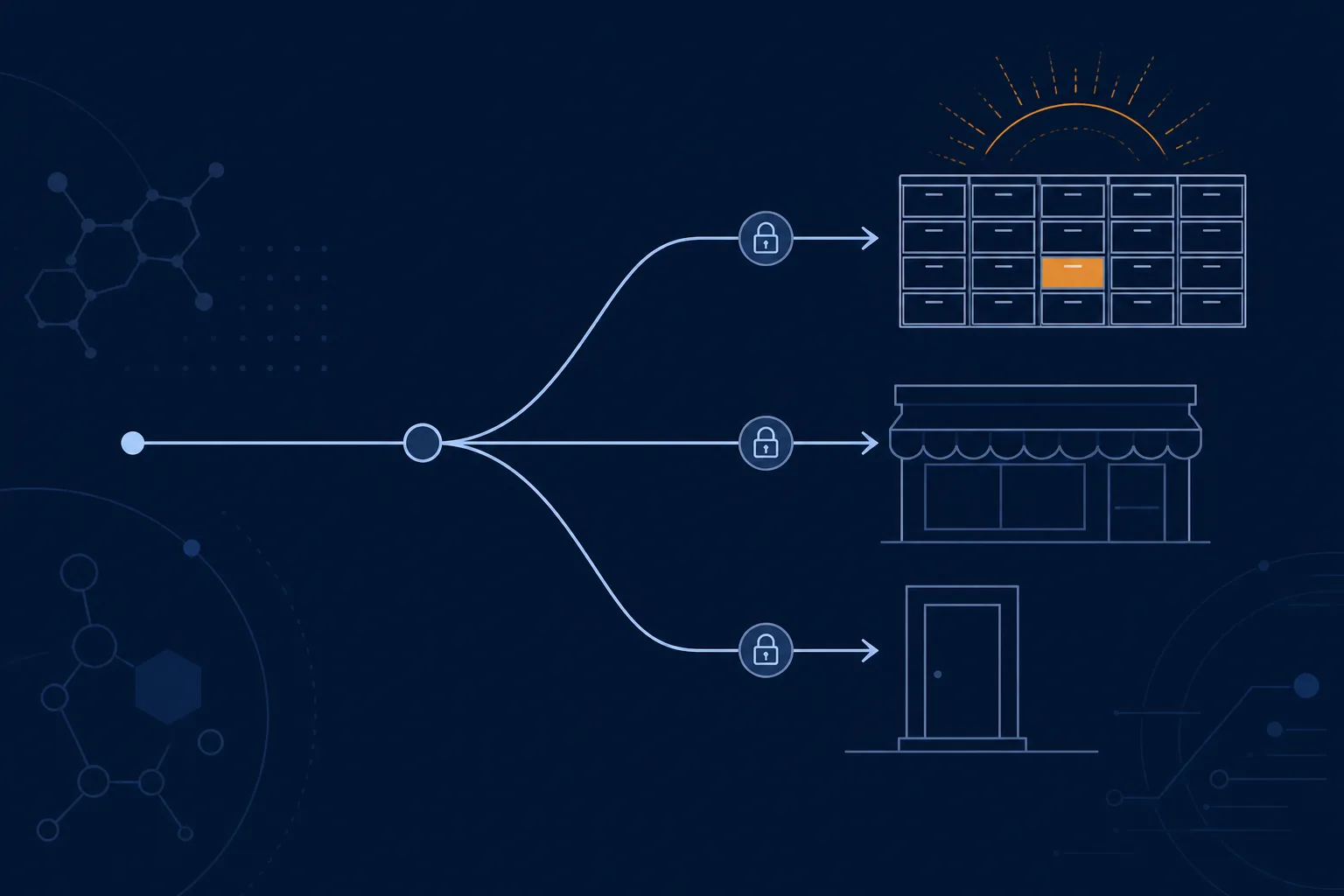
Delivery to an address, a pickup point or a locker
The three options differ in where the carrier's responsibility ends. With delivery to an address, the item is handed to the recipient in person or, if they are absent, to a person living at the same address, or to a service point the sender or principal chose from those the company offers [1]. At a pickup point, the parcel waits in a network branch or a partner business. At a locker, it waits in a closed compartment that opens with a code, with no person involved.
| Option | Who can collect | How identity is checked | Where the parcel waits |
|---|---|---|---|
| To an address | The recipient or a person living there | Signature, possibly a document or PIN | In the delivery vehicle until handover |
| At a branch or service point | The recipient or an authorised person | Identity document at the counter | On the premises, in whatever conditions they have |
| At a locker | Whoever holds the code | PIN or app, with physical presence | In a closed compartment, often outdoors |
What identification is asked for, and why
Identification at collection is not a check on what you ordered; it is proof of delivery. Handover ends the carrier's obligation, and the signature or code is the evidence that the parcel reached the right hands. That is why the level of identification follows the service rather than the contents: a plain delivery may rely on a signature, while a service with identification asks for a document or PIN, possibly at extra cost [1].
Recording identity details is processing of personal data and falls under the General Data Protection Regulation, one of whose core principles is data minimisation: data must be adequate, relevant and limited to what is necessary for the purpose [4]. In practice, you are entitled to ask exactly what is recorded when you show your ID at the counter. For a laboratory receiving on behalf of an institution, it is also worth deciding in advance whose name shipments go out in, so identification does not stumble on a mismatch between the name and the document.
- The recipient name on the shipment must match the document shown by whoever collects.
- The mobile number on the shipment must belong to whoever will go to the locker; the code goes there and only there [2].
- A locker code is not shared in group chats: whoever has it, collects.
- For shipments in an institution's name, designate one or two people who collect, not "whoever is in the office".
Authorising a third person
For delivery to an address, the terms allow handover to a person living at the same address when the recipient is absent [1]. At a branch, a third person needs more than goodwill. An authorisation can now be issued digitally through the gov.gr platform using Taxisnet credentials: it carries a unique verification code and is equivalent to a document with a certified signature [5]. What each service point accepts, however, is set by the carrier, not by the platform. Ask before you send someone, and make sure they also carry their own identity document.
For a locker, "authorisation" is simply forwarding the code, and that is exactly why it should be done deliberately. Whoever goes to the locker also takes on responsibility for moving the parcel straight into the right conditions. A box left for two hours in a car boot in July has had a worse journey than it had across the carrier's entire network.
How long the point holds the parcel, and what happens next
Each network sets its own holding time, and the time is stated in the notification. At ACS lockers the usual holding time is two calendar days from the date of the notification; if the parcel is not collected by then, it can be collected later from the corresponding ACS branch [2]. The detail matters: calendar days, not working days, so a notification on a Friday runs out over the weekend.
The holding time starts with the notification, which is why the notification is the weak point. A message that went to a colleague's mobile, to a shared laboratory inbox or to a spam folder counts exactly as much as one you read. If you are expecting a parcel at a locker, follow the tracking with the shipment number rather than waiting for the message, and during holiday periods decide in advance who will collect. A parcel moved from the locker to a branch makes one more journey and spends one more day somewhere you did not choose.
If delivery is not completed for any reason, the parcel goes back to the sender. ELTA's terms provide that the return is charged at no more than the original postage, and that an item that cannot be delivered to the sender either is kept for six months at the company's premises before it is treated as finally undeliverable [1]. For laboratory material, this means a forgotten parcel is not "lost"; it comes back after a journey that has made it unfit for use. Returning such material, and what follows from it, is covered in the article on returns and cancellations.
Holding conditions at the pickup point
This is the point most buyers never consider. International guidance on good storage and distribution asks that storage areas for temperature-sensitive products have controlled conditions, mapped and monitored [6]. A pickup point is not such an area and does not claim to be. It is a kiosk, a petrol station, a shelf behind a till, or a metal compartment on an outside wall. In July 2026, when stations of the National Observatory of Athens were recording maximum air temperatures above 43 °C [7], a west-facing locker was among the hottest points on the entire route.
The yardstick is the reference conditions for holding freeze-dried material as the supplier states them, and the gap between those and the environment of the point is the real selection criterion. For dry material and a short wait, an indoor, air-conditioned point is usually acceptable. For chilled material, no locker and no kiosk is suitable for more than a few hours, because the ice pack keeps melting regardless of whether the parcel counts as "delivered".
- Prefer an indoor point in an air-conditioned space to an outdoor locker, especially from June to September.
- If a locker is the only option, choose one that does not get the afternoon sun, and collect on the day of the notification.
- Take an insulated bag and carry the parcel straight to storage, not to the car for the rest of the day's errands.
- Photograph the closed parcel when you collect it from the point, with the label and the time visible, before opening it.
- Note in the receipt record that the parcel was collected from a point rather than delivered to an address, with the notification time and the collection time.
When delivery to the laboratory is the better choice
Delivery straight to the laboratory, with the recipient present, is almost always the best option when any of the following apply: the material travels chilled, the accompanying documents need checking immediately, or the recipient may need to lodge a reservation. That last case has a strict deadline: ELTA's terms allow the recipient to accept delivery under reservation, but the reservation must be declared within one working day after delivery [1]. A parcel left closed in a locker or an office drawer can pass that window before anyone has looked at it.
ΕΕΤΤ, the Greek postal regulator, advises people receiving distance purchases to inspect the parcel on delivery and record any visible damage [3]. In a laboratory that happens naturally, because a laboratory's acceptance criteria and receipt log are already in place. At a kiosk it does not happen at all. The detailed sequence of arrival checks is in the goods-in checklist, and checking the seal in the article on tamper seals.
References
- Γενικοί Όροι Παροχής Υπηρεσιών Ταχυμεταφορών Εσωτερικού — Ιανουάριος 2025ΕΛΛΗΝΙΚΑ ΤΑΧΥΔΡΟΜΕΙΑ Α.Ε. (ΕΛΤΑ Courier), Γενική Άδεια Ταχυδρομικών Υπηρεσιών ΕΕΤΤ, ΑΜ 99-150, 2025
- Παραλαβή από ACS Locker χωρίς οθόνη — χρόνος παραμονής και τρόποι παραλαβήςACS Courier (acscourier.net), σελίδα όπως δημοσιευόταν τον Σεπτέμβριο του 2026
- Υπηρεσίες Courier: Τι προσέχω όταν παραλαμβάνω αγορές μέσω InternetΕθνική Επιτροπή Τηλεπικοινωνιών και Ταχυδρομείων (ΕΕΤΤ), δελτίο τύπου 16.11.2022, 2022
- Regulation (EU) 2016/679 of the European Parliament and of the Council on the protection of natural persons with regard to the processing of personal data (General Data Protection Regulation)Official Journal of the European Union (EUR-Lex), 2016
- Ψηφιακή έκδοση υπεύθυνης δήλωσης και εξουσιοδότησηςgov.gr — Ενιαία Ψηφιακή Πύλη της Δημόσιας Διοίκησης
- Annex 7: Good storage and distribution practices for medical products (WHO Technical Report Series No. 1025)World Health Organization, Expert Committee on Specifications for Pharmaceutical Preparations, 2020
- Κορυφώθηκε ο καύσωνας στη χώρα με τη μέγιστη θερμοκρασία να ξεπερνάει τους 43°C στο Λευκοχώρι Φθιώτιδας. 28 σταθμοί κατέγραψαν πάνω από 40°C και 138 σταθμοί πάνω από 37°C.meteo.gr — Εθνικό Αστεροσκοπείο Αθηνών, 2026