How to read a peptide Certificate of Analysis (COA)
A COA is a test report covering one specific lot, not a quality seal — here is what each field actually evidences, and where the proof stops.
A Certificate of Analysis (COA) is not a quality seal: it is a test report covering one sample, from one lot, on one date. Read it in a fixed order — first the lot identity, then which laboratory ran the tests and under what accreditation, then which methods were used and against what acceptance criteria, and only last the purity percentage. Reverse that order and look at «99.2%» first, and you have already accepted a number without knowing what was measured, by whom, on which material.
The difference between a COA that evidences something and a COA that merely decorates a product page is almost always the same: the first lets you mentally reconstruct the test, the second asks you to believe it. Method, column, detection wavelength, gradient programme, retention times, integration table, theoretical and measured mass, laboratory name, report number. The more of those are missing, the less the certificate certifies.
What a COA actually certifies
In regulatory language, a «specification» means three things together: a list of tests, references to the analytical procedures that perform those tests, and acceptance criteria — numerical limits or descriptions the material must conform to [2]. A COA is the other face of the same document: it reports what was actually measured. If the acceptance-criteria column is missing, the measured number has nothing to be compared against, and the «PASS» at the end of the line is decorative.
For synthetic peptides, general chapter 1503 of the United States Pharmacopeia sets out explicitly which quality attributes belong in such a specification: identity, purity and related impurities, peptide content, counterions, water content, residual solvents, microbiological contamination and bacterial endotoxins [1]. A COA reporting only an HPLC purity percentage covers one of those eight.
The identity fields you check first
Before any analytical judgement, the document has to prove it describes the material in your hand. That is a matching check, not chemistry, and it fails more often than you would expect: an immaculate COA referring to a lot you cannot find anywhere on the vial label is evidence about somebody else's material.
- Name and full sequence in one-letter or three-letter amino acid code — the sequence, not just the trade name.
- Molecular formula and molecular mass, monoisotopic and average given separately, so the value the mass spectrum reports can be checked.
- CAS number, where one is registered.
- Lot or batch number — identical on the document and on the vial label.
- Manufacturing date, date of analysis and retest date: three separate dates, not one.
- Salt form (trifluoroacetate, acetate or hydrochloride) and a description of the material's appearance.
- Name and address of the laboratory that ran the tests, the report number, and the authorised signatory.
HPLC purity: what «99%» actually measures
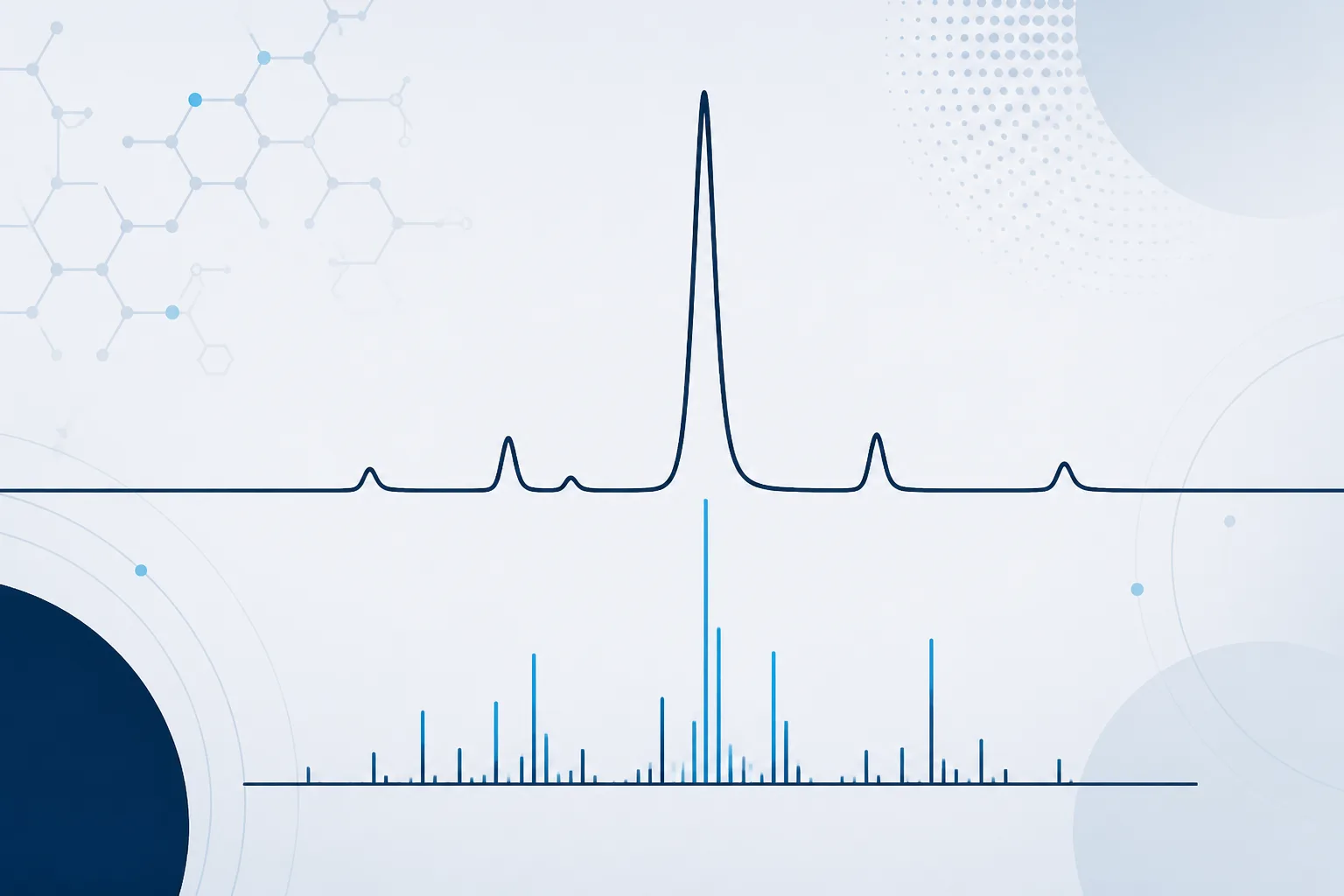
Purity on a peptide COA almost always comes from reversed-phase liquid chromatography with ultraviolet detection at 214–220 nm, where the peptide bond absorbs. The value is an area ratio: the area of the main peak over the total area of all peaks. It is not a percentage by mass, and the distinction is not pedantry. A truncated sequence with fewer peptide bonds absorbs less and is under-represented in the chromatogram; an impurity that co-elutes with the main peak does not appear at all. Both are examples of what a purity percentage leaves outside the frame.
This is why ICH Q6A asks for impurities to be specified individually and in total, with reporting and identification thresholds, rather than collapsed into a single number [2]. And it is why a percentage without the chromatogram is a claim rather than data: without axes, gradient programme, column, wavelength and integration table, you cannot see whether the «clean» peak is narrow and symmetrical or a broad shoulder that was integrated generously.
What hides in the remaining percentage is largely predictable, because solid-phase synthesis chemistry produces it. Chapter 1503 describes the main classes [1]:
- Deletion and insertion sequences, missing or carrying one extra residue.
- Truncated sequences from incomplete coupling.
- Incomplete deprotection and residual protecting groups.
- Epimerisation: diastereomers carrying D-configuration residues, identical in mass to the correct product.
- Oxidation of methionine, tryptophan or cysteine, and deamidation of asparagine or glutamine.
- Dimers, aggregates and incorrectly formed disulfide bridges.
That these impurities are not theoretical is shown by a published case: synthetic peptide libraries from two independent commercial suppliers were found to contain foreign peptides at roughly 1% by weight — enough to generate false-positive results in immunological assays, with one set of HIV-1 peptides carrying a cytomegalovirus peptide contaminant [7]. The stated purity was high; the contaminant was biologically active. This is a laboratory finding in in vitro immunological assays, not a clinical study.
One last check concerns the method itself. ICH Q2(R2) sets out the characteristics that must be demonstrated for an analytical procedure to be considered fit for its intended purpose: specificity, accuracy, precision, range and quantitation limit [3]. A COA reporting «99.4%» with no statement of method validation is reporting a number of unknown uncertainty.
Purity and peptide content are not the same quantity
This is where the most common misreading happens. HPLC purity states what proportion of the peptidic material is the correct sequence. Net peptide content states what proportion of the powder in the vial is peptide at all. The remainder is counterion, adsorbed water and residual solvents: material that weighs, but is not the molecule.
The two values come from different methods. Content is determined by quantitative amino acid analysis, in which the material is hydrolysed under acidic conditions and the liberated amino acids are separated and quantified, or alternatively by elemental nitrogen analysis. Chapter 1503 treats them as separate quality attributes precisely because neither substitutes for the other [1]. A lyophilised trifluoroacetate salt can simultaneously be 99% pure and appreciably less than 99% peptide by mass, with no contradiction.
Identity: what a mass spectrum proves and what it does not
Identity is established by mass spectrometry, usually ESI-MS or MALDI-TOF, and the COA should show three things together: the theoretical mass, the measured mass, and the tolerance. On a MALDI-TOF instrument the tolerance is typically on the order of one Da, while high-resolution instruments report deviation in ppm. Without a stated tolerance, two numbers agreeing is not a check.
There is also a limit that commercial COAs rarely declare: intact molecular mass is not sequence. Leucine and isoleucine are identical in mass; lysine and glutamine differ by roughly 0.036 Da, meaning they coincide on the nominal scale; D and L epimers are exactly isobaric. An intact-mass spectrum that «matches» rules out gross errors — it does not confirm the sequence. That requires tandem mass spectrometry or Edman degradation, and if the COA does not report either, the sequence remains a supplier statement.
Counterion, water content and what the chromatogram never shows
Reversed-phase purification is usually run with trifluoroacetic acid in the mobile phase, so the lyophilised product is isolated as a trifluoroacetate salt. That ion is not an inert bystander. In cell culture experiments, trifluoroacetate was found to inhibit the proliferation of osteoblasts and chondrocytes at very low concentrations, with the effect not confined to a single cell type or species [8]. These are in vitro findings in rodent cells, not human data. For anyone designing a cell-based assay, the «counterion» field is an experimental variable, not a packaging detail.
Three further fields belong in the same category and are absent from most commercial COAs: water content by Karl Fischer titration, since lyophilised peptides are hygroscopic and adsorbed water shifts every weight-based calculation; residual solvents, reported in ppm; and bacterial endotoxins together with bioburden, which matter for any work involving cells. The European Medicines Agency guideline on the development and manufacture of synthetic peptides, in force since 1 June 2026, treats the impurity profile as something to be documented systematically rather than reduced to a single figure [6].
Who ran the tests: accreditation and independence
The most overlooked field is the last one: who signs. A COA produced in-house by the manufacturer is not worthless, but it is self-reporting. A third-party report names the laboratory, gives a report number, the date the sample was received and a description of the sample as received — details that let somebody else return to the same record.
The international standard for the technical competence of testing laboratories is ISO/IEC 17025:2017, which specifies requirements for competence, impartiality and consistent operation, and which accreditation bodies use as their assessment criterion [4]. In Greece it is published as ELOT EN ISO/IEC 17025:2017, and accreditation is granted by the Hellenic Accreditation System, E.SY.D. [5]. Two points are worth holding onto: accreditation is granted per method and per scope, not to a company as a whole, and every accredited laboratory has a certificate number and a published scope of accreditation. A logo with no number and no scope is a graphic.
| COA field | What it evidences | What it looks like when weak |
|---|---|---|
| Lot number | That the document covers the material in your hand | Absent, or not matching the vial label |
| HPLC purity | Main peak area as a proportion of total peak area | A percentage with no chromatogram, column or wavelength |
| Chromatogram | Peak shape, separation, how integration was done | An image with no axes, or one shared across products |
| Mass spectrum | Theoretical versus measured mass, with tolerance | A single value, with no reference and no tolerance |
| Net peptide content | How much of the powder is peptide | Not reported at all |
| Counterion | Trifluoroacetate, acetate or hydrochloride salt | Not declared |
| Water content | Water by Karl Fischer titration | Not declared |
| Laboratory and accreditation | Who measured, and under which accredited scope | A logo with no certificate number |
| Dates | Manufacture, analysis and retest | One date, or none |
Eight signs the document evidences nothing
- The lot number is missing, or appears nowhere on the vial itself.
- A purity percentage is given without the chromatogram being shown.
- The chromatogram is an image with no axes, no scale and no retention times.
- The same chromatogram appears across more than one product, or across different lots.
- No method is stated: no column, no gradient programme, no detection wavelength.
- The acceptance-criteria column is missing, so the «PASS» is compared against nothing.
- The mass spectrum gives one value, with no theoretical mass and no tolerance.
- No laboratory is named, or an accreditation logo appears with no certificate number and no scope.
Where the proof stops
Even an immaculate COA certifies one sample, from one lot, on one date, inside one laboratory. It says nothing about what happened afterwards: transport temperature, time out of refrigeration, repeated freeze-thaw cycles, the quality of reconstitution, or simply whether the vial you are holding really came from that lot. Documentation is a chain: COA, lot label, receiving record, storage-condition log. A missing link weakens the rest.
One thing this category avoids saying should be said plainly: there is no published, independent survey of COA quality across the research-peptide market. The documentation we have is pharmacopoeial and regulatory, written for medicinal active substances [1][2][6], plus isolated analytical case reports [7][8]. Any claim about what is «typical» on commercial COAs is therefore an estimate rather than a measurement — and estimates do not belong in a laboratory record. The practical consequence is conservative: anything you cannot trace back to a named method, laboratory and lot is recorded as undocumented.
The Greek and European framework
One point causes persistent confusion: a COA is not a regulatory approval. Research-use-only material is not a medicinal product, holds no marketing authorisation from the National Organisation for Medicines (EOF) or the European Medicines Agency, and falls outside European Pharmacopoeia monographs. The standards referenced here serve as vocabulary and as a benchmark — they show what a complete impurity discussion looks like — and not as a claim of compliance [2][6].
Conversely, accreditation to ELOT EN ISO/IEC 17025 is entirely applicable and, more importantly, checkable: it concerns the testing laboratory rather than the product, and each body's scope of accreditation is published [4][5]. It is the one point on a COA where a claim can be verified independently, with no laboratory and no sample — which is why it deserves to be checked first.
References
- 〈1503〉 Quality Attributes of Synthetic Peptide Drug SubstancesUnited States Pharmacopeia (USP–NF), 2021
- ICH Q6A — Specifications: Test Procedures and Acceptance Criteria for New Drug Substances and New Drug Products: Chemical SubstancesInternational Council for Harmonisation (ICH), 1999
- ICH Q2(R2) — Validation of Analytical ProceduresInternational Council for Harmonisation (ICH), 2023
- ISO/IEC 17025:2017 — General requirements for the competence of testing and calibration laboratoriesInternational Organization for Standardization (ISO), 2017
- Αίτηση για Διαπίστευση Εργαστηρίου κατά ΕΛΟΤ EN ISO/IEC 17025:2017Εθνικό Σύστημα Διαπίστευσης (Ε.ΣΥ.Δ.), 2017
- Guideline on the development and manufacture of synthetic peptides (EMA/CHMP/CVMP/QWP/367182/2025)European Medicines Agency (EMA), 2025
- Peptide impurities in commercial synthetic peptides and their implications for vaccine trial assessmentClinical and Vaccine Immunology, 2008
- Trifluoroacetate, a contaminant in purified proteins, inhibits proliferation of osteoblasts and chondrocytesAmerican Journal of Physiology — Endocrinology and Metabolism, 1999